





Though it’s officially defined as a belief in gender equality, the word “feminist” seems to mean different things to different people…
Who doesn’t believe in equality? Assh*les, that’s who. But tell that to your brother when he wants you to stop pointing out every misogynistic moment in Two a Half Men, or your Mom when she wonders why you’re so angry or Scott Baio, who thinks feminists are all lesbian shitasses.
Maybe you get judged for being a feminist, maybe you don’t bring it up with your family, or maybe you’re way past that and you’re introducing feminism to your own children. Or maybe you don’t even identify as a feminist at all.
Autostraddle was founded way back in March 2009 in part to push our radical lesbian feminist agenda, obviously.
But for those of us who do, especially those of us also campaigning actively against racism and homophobia in our own lives, we often wonder: What is the purpose of all this shouting and “consciousness-raising”? How do we turn our anger into activism? How do we make it work?
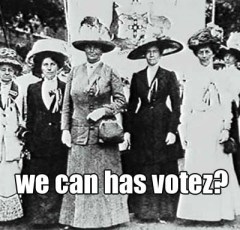
Feminism has undergone profound change since first-wave feminism started burning up the 19th century in Europe and the US. Back then, when men owned their wives and women were deemed unfit for education, there was a ton of shit that needed to change and FAST. And in that regard, feminists have made such swift strides in some areas that many believe the work is done — and it’s not. Furthermore, many women of color, queer and/or working class women still feel feminism is still a rich white woman’s movement that doesn’t address their concerns.
Autostraddle was founded way back in March 2009 in part to push our radical lesbian feminist agenda, obvs. Where other lesbian media often develops in tandem with gay male media & gay male issues, we wanted AS to develop from a different angle — a LADY angle — in tandem with feminist media & feminist issues. And so it’s time we officially start talking about that with you.
This “job”/volunteer opportunity tends to make you hyper aware of the daily frustrations of fighting for equality, which means we have a LOT of feelings to vent.
So we’re splitting this roundtable into three posts with a different question each time. Oh! Like the three waves how clever! If you’re new here, check out some of our previous Autostraddle Roundtables, like:
What Does a Lesbian Look Like
What We Talk About When We Talk About Healthcare
When Did You Know You Were Gay?
Is There a Lesbian Generation Gap?
So … Prop 8 Was Upheld. What Do We Do Now?
I’d Rather Laugh With the Sinners than Cry With the Saints
Adam Lambert – First Gay American Idol?
We also brought in a guest blogger to share his thoughts…. a boy! He’s queer, his name is JC Gonzalez, and he blogs at Bright Pink Tears. And hey, if you read this and think there’s a valuable perspective missing, hit up sarah [at autostraddle dot com] and/or laneia [at autostraddle dot com] about participating in Round 2 as a guest.
This Roundtable is SUPER LONG ’cause there’s a ton of people working here now, and we don’t even include everyone.
Today, we’re going to start with the basics:
Question 1
Are you a feminist? If so, when did you start identifying as one, and what was it like when you first got a grasp on what feminism really means? If you ever did NOT identify as a feminist, why not?
+
.+
 TAYLOR, TECH EDITOR: From my early teens on, I felt this unnamed oppression — that I had something very dangerous to conceal. And subconsciously, I felt that letting on that I was a feminist would’ve let the cat out of the bag.
Thinking back (just now actually!), I realize that I had a lot of weird proto-feminist shame as a teen. And that’s really sad and also really f*cking stupid. I was definitely stifled by this ridiculous cartoonish stereotype (that I honestly must have conjured out of thin air) where a feminist was impossibly militant, fiercely man-hating and probably a big scary dyke. I don’t think I’ve ever verbalized how I felt during those years, or really realized it at all. I certainly identified as a feminist to myself, but it was a dirty word. To others, mostly guys, I played down my identification with the word, which in retrospect is really kind of tragic. I mean, if anyone properly explained that feminism was about equality and not superiority or anything absurd like that, then I think my peers (in suburban Texas) would have been really pretty receptive. Everyone was actually surprisingly open-minded, but we were all held back by this ambiguous, dangerous specter of feminism that sure as hell didn’t have a face in our community. Like, where exactly were these horrible man-hating lesbians? They didn’t frequent our mall, I’ll tell you that much. They were the stuff of legend, I guess.
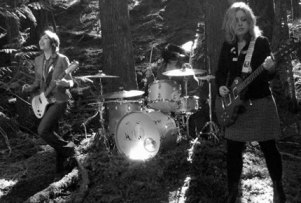
Throughout those years, music was the way I both expressed and was shamed by feminism. I’ve always listened to a lot of female musicians, you know, women being half the population and all. Lady rockers became my biggest role models, and I found my way into some Riot Grrl stuff, thank god. Sleater-Kinney, Le Tigre and PJ Harvey were instantly my feminist confidantes. But sadly, that’s where the shame comes in. Any power the music infused me with was tainted by the shame of identifying with this dangerous, raw feminist energy. It got kind of complicated. I’m not sure how my developing queer little brain handled that.
“I began to hear some very damaging comments about why I liked ‘angry chick music.’ I can’t even hear that phrase any more. I actually may have to maim someone, it’s so infuriating (maybe that’s why those chicks were so f*cking angry, huh?)”
+
Even though only roughly half of the music I listened to was by women, that was enough to rouse suspicion. I began to hear some very damaging comments in middle school and early high school, deceptively simple questions about why I liked “angry chick music.” I can’t even hear that phrase any more. I actually may have to maim someone, it’s so infuriating (maybe that’s why those chicks were so f*cking angry, huh?) I’m just not sure why high school boys felt so threatened by women in bands and women playing instruments. Even my dad condescendingly inquired about it, accusing me of “hating men” since I listened to “so much girl music”. I got pretty sick of it in late high school, when I finally starting steeling myself against the barrage of sexist/homophobic absurdity. The turning point was probably when my best friend and I started riding around in his shitty convertible through the suburbs blasting Sleater-Kinney’s “Dig Me Out” and singing along at the top of our lungs. It was very freeing. Maybe that kind of primal energy was what everyone was so afraid of?
 I think music was so important because as a teen, you really wear your heart on your sleeve with what you listen to. And I didn’t want that heart to look gay or like a feminist or anything suspect at all. It’s pretty powerful stuff during those years, when the voice coming through the speakers might be the only one you can relate to or confide in. And it can make you extremely vulnerable. I remember one really close, fairly enlightened friend telling me that he “didn’t feel like listening to girl music” in his car one day when we were trying to figure out what CD to play. I was betrayed. He and I had listened to that kind of music before. And I was like “I didn’t know gender was a genre?” But of course, tragically, I didn’t say that — I didn’t say anything. I just boiled over silently with a toxic mixture of rage and shame.
In late high school, I finally came into my own and learned to stand up for small outrages like this, but I think at the time, I conflated feminism with my sexuality. I wasn’t comfortable or even aware of my sexuality until I was about 18. But I think from my early teens on, I felt this unnamed oppression — that I had something very dangerous to conceal. And subconsciously, I felt that letting on that I was a feminist would’ve let the cat out of the bag. That somehow my listening to female musicians belied my sexuality in an obvious way. Even though those two things weren’t at all related for me.
+
 GLENNISHA, MUSIC WRITER: It was nothing new to me to want equality.
I definitely identify as a feminist. I think I’ve always have had sentiments of a feminist, but I didn’t actually identify as one until I was about 20 years old. When I first got a grasp on what feminism really meant, it wasn’t a big deal to me because I always had those views. It was nothing new to me to want equality. It was also nothing new to me to stand up for what I believe in. I come from a family of very strong women. Growing up my mother always taught me to stand up for myself and more importantly to know and understand my value.
+
 ALEX, DESIGN DIRECTOR: My “female voice” class planted a pretty little seed in my 17-year old head, and that made all the difference.
There was this amazing teacher in my high school who established and taught an English elective called “Female Voice.” All the cool girls (like me) and even a few boys took the class, and it was definitely there that I learned to view the world through a “feminist lens,” (as our teacher put it.) We read The Yellow Wallpaper and The Handmaid’s Tale (among others) and deconstructed racial and social stereotypes in movies like Pretty Woman. At the time, we begged our teacher to spare ruining one of our favorite movies of all time — “why can’t we just enjoy it for what it is! Wahhh!” Silly us.
That’s funny and ironic now because I work for Autostraddle, where we socially deconstruct everything. And I’m totally fine with that.
I think a little bit of female history (and even some gay history) taught in high school classrooms would do everyone a favor. Critical thinking skills, people! WE NEEDZ TEHM. My “female voice” class planted a pretty little seed in my 17-year-old head, and that made all the difference.
+
 RACHEL, EDITORIAL ASSISTANT: I don’t know when I started using the word “feminist,” but I’m going to keep using it until all this shit stops happening.
I was, believe it or not, kind of a tomboy when I was young — I played on a boys’ baseball team, rocked Cleveland Indian t-shirts exclusively throughout the fifth grade, and I was always ready to rumble on the playground if you had a bad attitude. I was into “girl power.” And when it became clear that this was all weird and borderline unacceptable behavior — that the boys on my team thought I was weird for caring about sports, that my classmates thought I was a smartass for knowing the answers, that I was considered unladylike before I was old enough to wear a bra — it made me angry, and I’m still angry today. I remember in my Advanced Placement physics class in high school listening to the guy behind me joke about how right Larry Summers was, that girls really are just worse at math and science. I turned around in my seat and told him that that seemed weird, considering I had a better grade than him.
“I didn’t get an idea that real feminism could be about a lot more than girl power until college, when I took some classes and found some readings that made me realize equality is about more than splitting the check at dinner.”
+
 I don’t know when I started using the word “feminist,” but I’m going to keep using it until all this shit stops happening. I didn’t get an idea that real feminism could be about a lot more than girl power until college, when I took some classes and found some readings that made me realize equality is about more than splitting the check at dinner. When I was 19 or 20, suddenly it was like “Oh hey, there are three times more animal shelters than battered women’s shelters in the US, forced sterilization of women of color is still happening every day, and the rampant misogyny endemic to our culture is hurting EVERYONE, punishing queer people for nonconformist gender presentations and making us stigmatize women of color as unfeminine and hypersexual….” the list goes on. It’s one of those things where, once you start to really think about it, you can never stop, you know?
The amazing writers, speakers, and thinkers who have inspired me since then is practically neverending. I love love love Anne Lamott’s essays and all of Traveling Mercies; Alice Walker’s Possessing the Secret of Joy changed the way I think about everything, as does everything of James Baldwin’s. Cherrie Moraga’s work is a must-read especially for queer women, and when I read the anthology Jane Sexes It Up at like 16, I remember feeling like my life had changed completely, like I would never think about sexuality in the same way again.
 SARAH, ASSOCIATE EDITOR: I was secretly terrified of being gay or being different, so I never delved beneath the surface. But then I got to college.
I didn’t give feminism much thought until college. If asked directly, I probably would have identified as a feminist before then, but I didn’t really understand the implications. In high school, I actually didn’t think about much at all. I grew up in a very privileged town, and I avoided thinking deeply about my identity in any respect. I was secretly terrified of being gay or being different, so I never delved beneath the surface.
But then I got to college: I officially came out, I met some progressive feminists, and I started taking sociology classes. My friends and my classes forced me to learn about feminism, gender studies and queer theory. On top of that, being gay and having a computer allowed me to connect with a bunch of awesome women I probably wouldn’t have met otherwise, and their influence has especially shaped my feminist views. I started thinking about things I had never thought before. Did you know studies show that married heterosexual women do the same amount of housework whether they have a job or not? And “the same amount” is usually a pretty large amount. Reading things like that made me realize how much work was left to be done.
“…because even though living in ignorance can be blissful,
it’s actually a lot more fun to know who you are and know you’re a part of something important.”
+
So basically, I went from being oblivious to being a big feminist in just a few months. It’s such a cliche, but I became a completely different person in my first year at college. I’m SO thankful for that now, because even though living in ignorance can be blissful, it’s actually a lot more fun to know who you are and know you’re a part of something important.
Because all of this stuff happened at the same time for me, my gay identity and my feminist identity are intertwined. I tend to see all equality movements as one big effort. And the more involved I get, the more I think that’s true.
+
 CRYSTAL, MUSIC EDITOR: The moment I began identifying as a feminist was when my irritation and embarrassment over my mother’s protests turned into respect.
 My mother began teaching me about feminism at a really young age. The biggest lesson I can recall happened on my fourth birthday: she dragged me down to the local soccer club and refused to leave until they agreed to let me play for the boy’s under-5 soccer team. All the folks in our tiny redneck town got really upset about it, because it was a “boys’ sport.” I wasn’t too stoked either because of boy germs, etc.
I was too young to fully understand what she was trying to achieve. It wasn’t until I became a teenager that I started to make my own observations about inequality — largely demonstrated by some sexist employers — and then suddenly every fight I recalled my mother having during my childhood started making sense. So I guess that’s the moment I began identifying as a feminist: when my irritation and embarrassment over my mother’s protests turned into respect.
Unlike a few feminists I know, I’m no expert on the movement or theory. That’s mostly by choice, as feminism as a topic really stresses me out for a few reasons. I’ll protest and challenge authorities and even quit jobs in the name of equality, but ask me to discuss feminism on a political or philosophical level, and I’ll bee-line for the exit.
+
 JC GONZALEZ, GUEST ROUNDTABLER, BLOGGER/ARTIST/HOMOSEXUAL MAN BEHIND “BRIGHT PINK TEARS”: I realized that the only girls who received the least amount of hazing were ones who served male fantasizes and sexual expectations. I was quiet the entire drive home until I blurted out, “Mom, I think I’m a feminist.”
I’ve come a long way in the few years I’ve been defining myself as a feminist and as a queer boy. Terminology means nothing, though; I’ve always been both of those labels since childhood.
I grew up in the borderland of El Paso, Texas, in a dominantly Hispanic/Latino culture — a culture where feminist ideology, philosophy, literature, and entertainment is not only scarce but mocked. Luckily, I had my older sister. She was born 10 years ahead of me, so I naturally idolized her. She took me under her wing and made me listen to female artists since the day I was born. My training varied from Björk to Naked Aggression, from her making me read The Vagina Monologues in middle school to introducing me to Tank Girl comics instead of your standard male superheroes.
I like to think of it as training to survive and battle the oncoming years, when I would realize the existentialist complexities and social struggles of sex and gender. Soon I would enter high school, where I befriended a popular cheerleader who I respected greatly. She was sexually liberated, intellectually self-assured, confident, and unafraid to show assertive attitude. Naturally, with such characteristics she was also one of the most hated and gossiped-about girls in school. Another group of friends I had were girls who were not into physical superficiality, and focused on academics instead of make-up. These girls were also the subject of harsh criticism and hate.
One day, when being driven home from school by my mother, as I was not old enough to own a license, all this became apparent to me. I realized that the only girls who received the least amount of hazing were ones who served male fantasizes and sexual expectations. I was quiet the entire drive home until I blurted out, “Mom, I think I’m a feminist.”
That was my coming out moment. I ranted to her about all the gender-related injustices inflicted upon my posse of girlfriends and how macho boys made me sick to my stomach.
My mother went on to explain that it was merely the childish and foolish world of high school, a place where ignorance existed. I figured beyond high school these issues would drop dead, and was soon met with the reality.
By this time I could fend for myself when searching for feministic media. I discovered Bikini Kill and the Riot Grrrl revolution. In my sheltered and naive situation, the music was a breath of fresh air. Kathleen Hanna explicitly shrieked her way through the wrongs inflicted upon women in the world, and I was brought to tears when overwhelmed with emotion the very first time I listened to them. I was a lone star in my little world when it came to such blatant feminism, and listening to a like-minded band was validating and inspiring.
All of these young, budding experiences were a launch-pad to explore women’s studies beyond the world of entertainment. Buying essay collections like Sisterhood is Powerful and taking feminist art history courses, studying gender theory, and so on. I was a baby feminist as a teen, and now entering my twenties, I’ve come a long way.
+
 EMILY CHOO, INTERN With all the sexist jokes flying around, I kind of worked up in my mind that I didn’t like that and wished that we could all get along and live in blissful equality.
I’m not sure I ever knew what a feminist was, like the exact definition. I always knew that I wanted equality for women, but I never realized that that meant I was a feminist until I was about 16 and I figured out that feminists exist. It was kind of like when I discovered bisexuality, except less of a “eureka!” moment. I sort of grew into the feminist thing.
In high school I was in a sports program that was like 80-85% testosterone, and so with all the sexist jokes flying around, I kind of worked up in my mind that I didn’t like that and wished that we could all get along and live in blissful equality. JK, I wished that the dude in my class would stop saying that women should be in the kitchen. More importantly, I wished that girls would stop going out with him because a) they were only encouraging his behaviour, and b) I wanted to go out with them.
I think I always had strong female characters in my life, or rather, a gaping hole where my mother should have been. Unconsciously I probably tried to identify with her, and the fact that I thought about her a lot only made her female “presence” stronger. Also, I always looked to my aunt as a strong woman who had a really put-together life and who introduced me to The Spice Girls, who coincidentally were all about Girl Power.
 RIESE, EDITOR-IN-CHIEF: Feminism was about equal rights, which we already had (or so I thought). Girl Power was more like it, with its sexy Ginger Spices and Bridget Jonses and Carrie Bradshaws.
I grew up post-feminist. Feminism was what my Mom did before my birth in 1981 and why a woman allegedly needed a man like a fish needed a bicycle and why a little girl like me (though I often passed as male) could be whatever she wanted to be when she grew up. In Ann Arbor’s tiny liberal socioeconomically homogeneous bubble — and the even tighter seal of my gifted/alternative/arts schools — I generally befriended a racially diverse mix of precociously fierce girls and wiry emo bisexual boys with similarly idealistic upbringings.
The seal cracked sometimes, like when visiting strictly gendered family out-of-town, or on my soccer team with pretty public school girls who already shaved their legs and hadn’t read Our Bodies Ourselves. Over time, those cracks would destroy me/unearth necessary truths, but I didn’t know that yet. All I knew was I’d feel something gross/different clawing at me: something wretched & sad & needy for their Female-to-Female Approval.
This insecurity/depression soured me towards the Feminism that was preventing me, I felt, from knowing things I needed to know to be a Girl in the Real World of Bitches and Boyfriends. I didn’t want to be so “different” — and I certainly didn’t want anyone to think I was a lesbian. My Mom’s brand of in-your-face feminism seemed less and less like a liability I could afford. And although I was teased for being ugly & flat-chested and my friends & I cycled through every teenage girl tragedy addressed in Reviving Ophelia — eating disorders, self-mutilation, sexual or physical abuse, mental illness, et al — I didn’t see that feminism offered theories about & solutions for those issues, only that it was a political agenda sported by women who didn’t wear bras. And I really wanted to wear a bra! (I’m over that now.)
“Girl Power” was more like it, with its sexy empowered Ginger Spices and Bridget Joneses and Carrie Bradshaws.
I can’t sort out my memories besides that I clearly was feeling one way and acting another — not wanting to be seen as a lesbian, coupled with a ton of grief & depression & just a lot of issues — and to be honest, I honestly think a feminist lens could’ve really benefited me at the time.
I kinda enthusiastically embraced the capitalist patriarchal co-opted version of smart, progressive pro-sex feminism embodied by watered-down Girls (Gone Wild) Power. At 20, I was going to school, waitressing, and living in a condo with a frat boy boyfriend and a puppy, cooking him dinner every night. I was scared of women and had alienated most of my female friends. I’d go see “boy movies,” watch his shows & listen to his music, but my boyfriend dated me for ten months without reading a single word I’d written, let alone a word by Adrienne Rich. I internalized that double standard.
I started openly owning the feminist title maybe mid-college, after that relationship.
‘Cause throughout all of that; I’d been reading a lot! That’s the key! In addition to everything I learned in Sociology and other women-oriented classes, I read Schoolgirls: Young Women, Self Esteem and the Confidence Gap in early high school and decided my life goal was to make middle school easier for girls, as I’d been so colossally depressed for most of it. There was Bitch Magazine and Bust. The World Split Open: How the Modern Women’s Movement Changed America, Revised Edition changed my life. Also The Body Project. Over time I gradually stopped favoring male authors over female and now my favorite writers are all women: Lorrie Moore, Mary Gaitskill, Joan Didion, Pam Houston, Eileen Myles, A.M Homes, Megan Daum.
I read, and I worked with girls, tutoring, doing a photojournalism project at a pilot all-girls middle school, mentoring at a treatment center with sexually abused pre-adolescents, teaching at a juvenile detention center… at some point I saw the light, or maybe just stepped into the light.
“Don’t think gender discrimination in the workplace still exists?
Try waiting tables.”
I learned feminism’s importance real quick out there in “the real world.” Don’t think day-to-day gender discrimination in the workplace still exists? Try waiting tables! Once my naive, 18-year-old thrill of being objectified constantly wore off, I got angry about the daily sexual harassment and inexplicable disparity of weekly income — we tallied one week and found that regardless of race & sexuality, men made on average $150 more per week in tips than women working the same shifts. But that was nothing compared to the actual job market where our male friends seemed to seamlessly prosper while all my female friends struggled to get an unpaid internship or stay out of debt.
Now I’m completely insane, I start fights with strangers. I’ve basically been this way all along, I just didn’t use it before.
+
 KATRINA, EDITORIAL ASSISTANT: Being a woman and being a feminist finally made sense, and there was no need to hide it anymore.
The babyhood of my feminism began in high school — not really as a philosophy or identity, but just as a defense against a certain group of boys in all my classes who insisted that it was hilarious to make rude anti-woman comments all throughout every class, whether it be about the suffragettes, Joan of Arc, or Queen Elizabeth. Yeah, I know, it’s ridiculous. Seriously guys (girls? grrrls?), no one has had shit on Queen Elizabeth since like the 1700s, and besides, anyone who has done so has gotten their theoretical ass kicked by Helen Mirren anyway.
Not only did these boys feel the need to deprecate historical ladies, but they also sneered at any girl half willing to call them out and snickered at the mere mention of feminism. And so even though what these guys were saying was incredibly offensive, it seemed almost impossible to talk back to them (an entirely too familiar power dynamic – wussup homosocial behavior), and the rest of the class (not just the girls) was left silent. Until, of course, one day when I was feeling particularly indignant, and I suddenly found myself going all Hillary Clinton on their asses in a long tirade which concluded when I – to my own surprise – identified myself as a feminist and realized that as long as we are people in this world, we are affected by sexism, and as long as sexism exists, we should all be feminists.
“I – to my own surprise – identified myself as a feminist and realized that as long as we are people in this world, we are affected by sexism, and as long as sexism exists, we should all be feminists.
+
After a long, strange, queer freshman year of college, I had finally settled into my sexuality, only to be met with the trouble of gender. A brief period of genderqueer questioning was ended when my mother insisted that as long as I lived in her house, “I had to look like a girl.” I realized then that it was ridiculous for me to try to “look” like a woman, because, it turned out, I already felt like one. I’m a woman, yes, though unconventionally so, but I figured that it’s better that way. Why try to conventionalize my own identity or any identity at all? Being a woman and being a feminist finally made sense, and there was no need to hide it anymore.
Whenever someone is rude to me IRL or on the Internets, my girlfriend always tells me, “Haters make you famous.” But now it’s become clear that those who sip on the haterade and eat the hatertots have turned out another unexpected result: haters make me a feminist.
+
 LANEIA, EXECUTIVE EDITOR: I grew up irritated, confused, unknowingly gay, oppressed, sexualized, objectified AND THEN I MARRIED A MAN.
I was raised with a confusing message when it came to equality and gender roles. On one hand, I was told that no man was beneath or above me and to treat everyone with respect and kindness. At the same time, women in my family treated men completely differently than they treated each other. It was clear from pretty early on that men were good for yard work and making an impact in public (the idea of physical protection, being validated by a man’s presence, etc.), but that without a woman, most men couldn’t feed or dress themselves, pay bills, keep a house clean or raise a child.
“Like, I thought we were all equal here? At the same time, I was getting the explicit message that I needed a man to complete me. Also I just had a lot of issues.”
+
If I ever complained about how boys were allowed to behave like animals or assholes, the stock response was, “Laneia, they’re boys. That’s just how they are.” Well that’s enraging to hear at any age. And also really confusing! Like, I thought we were all equal here? At the same time, I was getting the explicit message that I needed a man to complete me. Also I just had a lot of issues.
 So I grew up irritated, confused, unknowingly gay, oppressed, sexualized, objectified AND THEN I MARRIED A MAN. You’d think that would’ve pushed me over the edge — and it almost did — but actually it was the death of my maternal grandmother a few years later that made me reevaluate pretty much everything. In the months before she died, I learned so much about her life and how she had navigated it.
It occurred to me that she’d been modeling feminism for me my whole life. She’d worked hard for an education, owned her own business, presided over the family finances with unrivaled authority and commanded the same level of respect that she extended to others. My grandmother had quietly practiced her own brand of rural feminism — the kind no one really talked about.
Unfortunately, I had the self-awareness of an amoeba (still do?) and failed to notice or appreciate any of her examples until my mid-twenties, when I started talking to like-minded women and questioning everything. What a super interesting, dramatic, emotion-filled time in my life! I was like, “Hey, baggage! There’s so very much of you! GOOD GRIEF, LET’S GET STARTED.”
My frustration and anger and feelings of unrest had a name: feminism! There were books to read and things to talk about and people who understood. It was all very life-affirming and slightly overwhelming.
+
 ZAHRA, INTERN:
What people say about a term is not necessarily what it means or what it stands for.
I’m not sure there was a particular moment when I did begin to identify as a feminist. I think I always knew that people of all genders deserved to live equal lives, or at least that’s how I felt about it. I can’t say that I go around telling everyone that I am a feminist. I just take it for granted. It seems to be something so strong in me that I forget that others don’t have the same thoughts. That means that I’m more surprised when someone makes comments that aren’t feminist and less so when someone says they are a feminist.
Of course, at a certain point I learned that there was a way of describing people who believed in equality for women (and gender equality in general). Part of me wants to say that the concept of feminism arrived separately — in the form of more negative “bra-burning” stereotypes — than the idea of gender equality. Reconciling the two came from educating myself, discovering that what people say about a term is not necessarily what it means or what it stands for.
+
 LILY, INTERN: I may be criticized for this, but I truly feel that the Spice Girls were a big part in the formation of my feminist identity.
I feel like I’ve always thought of myself as a feminist. I’m not quite sure when I started associating my identity with that specific word, but I also can’t remember a time when I wasn’t aware of that word’s existence. My parents made sure to raise me and my brother on the notion of equality between all genders, ethnicities, sexualities, and so forth. After church and catechism each Sunday (my dad is the most liberal devout Catholic in the world), my mother would be sure to remind me that a bunch of men wrote the bible, God is whatever gender/non-gender you make him/her/it out to be, and that Eve was blamed because of the patriarchal nature of the bible.
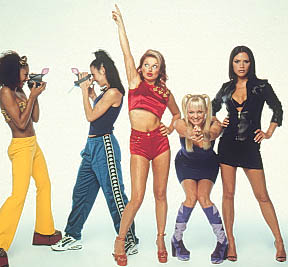 My mother is most definitely the person from whom I first learned about the ideas of feminism, and she has been my biggest role model in forming my identity. And I’ve always looked up to a number of strong women in my life, especially women musicians. I may be criticized for this, but I truly feel that the Spice Girls were a big part in the formation of my feminist identity. Ok, so they may have pranced around in minimal clothing while wearing gobs of make-up, but I don’t think either of those things are anti-feminist. They preached the ideal of “Girl Power” to their young, impressionable, and mostly female audience. Many of their songs had positive messages about the power of women, and even their movie didn’t focus on finding boys or some silly love story but rather on how hard each of the women worked to be successful.
To me, the word just means the belief in the equality of men and women, and why would anyone want to deny someone her equality? As I’ve grown older and begun to take classes on the ideas of feminism, I’ve come to question my knowledge of what feminism really is. I still consider myself a feminist, but I’m learning more and more each day about what that word can really mean.
 TINKERBELL: A lady-body and a male-body are almost the same kind. So why is it such a big deal.
Hello Autostraddle. This is Tinkerbell. As a very attractive female dog who lies on my bed and thinks about my boyfriend Littlefoot all day, I am a feminist. Littlefoot makes me so mad! In my years of life, I have not seen many things. Still I see that feminism is cool and because of my beauty and fame, I want to be the coolest catch on the block. My mothers are all feminists, and so is our lord Lady Gaga. Also I see Bust, Bitch, Jezebel, Feministing and other good-looking women being feminists. Everybody is equal obviously. Compared to my body, which I got stuffed at Build-a-Bear last year for Democrat Day, a lady-body and a male-body are almost the same kind. So why is it such a big deal. Thank you love Tinkerbell.




Comments
Ok, I’m a feminist. Always have been. Right from beating up the boys in primary school to playing rugby. It just makes sense as an intelligent woman! Ok, maybe the rugby doesn’t really make sense, but why should the boys have all the fun?
Anyway, the thing I don’t understand is how anyone can not be in favour of equality. It just doesn’t make sense to hold anyone back for something that doesn’t actually affect (for example) the job they do. We live in an illogical world!
Awesome article! I love it. :)
I believe in gender equality. If that’s what a feminist is, then I’m a feminist. But I’m going to have to think about it in a lot more detail because I don’t really know anything about feminism or what my personal views could be described as, so I’ll just be a lurker on this roundtable, reading everything.
That’s what I love about Autotstraddle; you guys makes me think about issues that I really haven’t been aware of before because of my age. Thank you for that.
aw, that’s great! thinking is the best!
<3 <3
As the child of an ethics professor and a human rights activist (who needs a Barbie when you can have a Nelson Mandela doll?), I guess feminism never was that far away, but the ball didn’t really start rolling until I was about 6 or 7 years old. I was discussing something with my best friend’s older brother when he smiled and said, “I think you’ll grow up to become one of those intellectual feminists.” Personally, I wanted to become a doctor, inventor or robot, but that’s when it all started.
It seems like several of you had problems with coming out as feminists because of your sexuality, but for me, it was kind of the other way around. I have always been opinionated, and was considered by myself (and the rest of the school/my world) as a feminist way before I started realizing that girls were way too pretty not to touch (yes, I’m that shallow..). Everyone already believed I was gay from the way I talked, but I never liked proving people right.
I can’t see pages 2 or 4 of this article. Did I so something special to break my computer, or is this a problem for everyone? (Or are those pages just pretend?)
Oh look…all better. I’m not sure whether to thank AS or the universe for fixing my computer, but now I can read. Yay.
Pages 2 and 4 don’t work for me either.
Me neither, just pages 1 and 3.
Love what I’ve seen so far though! and great job on this, thank you.
I wasnt really a feminist until I got into uni and started going on work practice with veterinarians. Every single farm we went to, and I mean every single one, the farmer always thought it was completely hilarious that a girl, and a short one at that, was going to be a vet. They didnt even care if I was good or not, in their minds I was instantly worse than my male counterparts just because of my sex. Every single time and on every single case I had to work ten times harder than my male colleagues just so I could prove myself capable…and that, obviously, really pissed me off. And I realised that it’s the same in most fields of work, gender inequality and outdated perceptions of women are still very much evident and hence I think it’s important that all of us are even a little bit feminist as we need to address this problem and solve it.
Anyway, im rambling and not really adding to the discussion. I must say that all of the above pieces were great, even the dogs one, and i’ll echo the sentiments above in saying that they all definitely made me think about ths issue more. I work as hard as I can for gay rights and in doing so I sometimes forget about womens rights which are just as important! Thanks AS.
In a high school economics class, my male teacher asked the class to raise their hand if they considered themselves a feminist. I raised my hand. My teacher raised his hand. And that was it. I was so infuriated that I rambled for 5 minutes about the misconceptions we’ve been fed about the word feminism. Even now, some of my dearest friends won’t ‘wear’ the term because of how scary it sounds. ASFKSFJSFSDF it pisses me off.
agreed. i’d say that 25% of my current friends group is like that to this day. these people went to college and are otherwise very rational, equality-minded people! AHDVJMDAKE$HAvskngskr
see, there’s this nasty rumor going around that all feminists are “lesbian shitasses” (which is not true, i am very clean). but srsly tho, keep rambling! build your own soapbox! point the could-be feminists to the nearest women’s community center! WAKAWAKAMSTRKRFTVELVEETA
Recently I asked my partner’s sister if she considers herself a feminist. She said she wasn’t sure if she could use that title because she didn’t want to do/not do any of the things that feminists are “supposed” to want. I said, “Well, you support our right to have those things, right?” Well, of course. Hmm. Why can she not say she’s a feminist again? >_<
Ah, Autostraddle. How I love you. This is such an interesting discussion to have! When I was younger, I guess I saw feminism more simply, just as equality between men and women. But in one of my courses at college this year we read some Luce Irigaray, who basically said that the way philosophy is structured and even the English language itself is based around masculinity and does not allow us to accurately speak about women. So now I feel like it’s so much more complicated than equality, there are many more layers to being a feminist, and so many different ways view feminism. It’s kind of exciting.
Anyway, it’s great to read everyone’s perspectives and I can’t wait to read the other parts of this roundtable!
I wish I’d learned more about linguistics when I had the chance. I’m super interested in checking some of that stuff out- I always think about gender bias in language (especially in ANY kind of language pertaining to sex or medical terminology) and would love to learn more! Have a starting place you’d recommend?
Well, I’m not any sort of expert in the subject, but what I read was the essay When Our Lips Speak Together (by Irigaray). She writes so that the text is deliberately difficult to interpret, conditioned as we are to the male-centric way of arguing, and because of that I don’t think that I fully understood everything that she was saying. But it still made for an interesting read and I would definitely recommend it!
thank you!
And if you want a quick sample of someone who tried to create and speak in a “female” language, check out the poetry of Gertrude Stein. Feminism wasn’t the only reason she avoided (what she termed) “masculine” linear language, but it was part of it.
http://bit.ly/dcBEMB
Ken Browne’s Introduction to Sociology (Google Books). Check out the chapter on Gender (available in the preview), it does touch upon the language issue as well as stereotyping and the influence of family and school.
Oh, and Adrienne Rich on poetry: ‘Poetry is, among other things, a criticism of language. In setting words together in new configurations, in the mere, immense shift from male to female pronouns, in the relationship between words created through echo, repetition, rhythm, rhyme, it lets us hear our words in a new dimension.’
Can I please request that Tinkerbell start structuring her syntax like Alex the Ukrainian tour guide in “Everything is Illuminated?” She’s kind of on her way and that’d really make my day.
omg, when i was reading that book i started talking like that as well. i loved that voice. i will mention this to tinkerbell
I second this request wholeheartedly!
I’ve got a feeling there are going to be many epic comments about this. I’m not sure how to piece my own jumble of feelings together without making a picture of a self-indulgent, privileged, white, first-world, middle-class, cis female with all limbs still attached to a non-obese body, but hey, that’s the truth so fuck it.
I’ve never not been a feminist. Yet if I was to list all the words that describe me, I don’t know how far down feminist would appear, or if it would even occur to me to include it at all. I think that feminism can’t exist where there is no gender inequality; for much of my youth I was so oblivious to (or worse, ambivalent about) inequality that it obviated my need to be an active feminist.
I went to an academically selective, all-female high school, in a comfortable, leafy suburb. You’d have thought that an atmosphere rife with the oestrogen and imagination of intelligent young girls would be the perfect breeding ground for fledgling feminism, but I found it to be the opposite. In the absence of boys, I guess there was just no-one to feel subjugated to. Lots of the stories above involve early antagonism between genders to spark the feminist flame, I never had that; outside of school, my best friend (boy) and I happily played football and Nintendo together every night. It didn’t occur to me that this might be unusual, it was just…fun.
So when I went to uni to study a hugely male-dominated subject (computer science), things should have flipped around, right? Sure, it was notable that I was among only a handful of girls, but it never once occurred to me that this had anything to do with me personally, or that this should affect how I lived or worked in any way.
I read a few feminist books in my late teens, I remember lapping up Camille Paglia, but that was probably because the pro-porn, pro-sex stance seemed pretty exciting. I was pro-women, but that might have just been because I loved being a women and loving other women. There was still a connection I needed to make to women’s rights.
That connection didn’t happen overnight, but rather organically over a few years. It coincided with me growing up; daring to look beyond my own ivory tower. Just because I was in a position to refuse to be discriminated against, the same cannot be said for 99% of the world’s population.
Things that helped me along the way were: books like Global Woman; actually paying attention to the relationships between men and women around me; getting riled by the borderline-offensive “women in IT” emails I receive, which miss the point so wildly it makes me want to scream; seeing anything about institutionalised rape by the military in Congo, or the non-existent women’s rights in many middle-eastern countries, or just anything about the general horrendous heap of shit that constitutes women’s lives accross the world; realising I often want to strangle the passive-aggressive guys at work that whine about positive discrimination for women; finally, without wishing to sound sycophantic, websites like this, that pose the questions that sometimes I don’t even realise need asking.
I think I’ll have to buy a pint for anyone with the patience to read through this, but it’s been a quiet, private joy to be motivated to think about this stuff, so thank you.
Look forward to the future installments and everyone else’s stories!
you owe me a pint! i read the whole thing and found it very interesting!
You’re too kind. Hit me up next time you’re in England – I always pay my debts!
I read it as well, im curious what are these women in IT emails u receive.
what riese said :)
My girlfriend is a woman in IT too, and while she sort of has her head in the sand vis a vis how her male coworkers treat her… some of the stories she tells me makes me raeg. Like earlier this week, when a shipment of computers came in and all the guys went downstairs to haul them up, leaving her alone at the helpdesk… hurr.
I always knew I was supposed to be a feminist but growing up as a rather antisocial (in both senses of the word) boy, I hadn’t a clue about *how* to be a feminist. I still kind of feel like I’m fucking up in this respect but reading some feminist philosophy has helped a little.
Now most men I know have about the same grasp of what feminism is all about as I did in junior high; but while I knew it was something good, they seem sure that it’s something contemptible, unnatural and unjust. Baffling as it is, it’s not really surprising that a patriarchy should produce such attitudes in self-defense.
Also, the socialization of boys revolves entirely around avoiding effeminacy. It seems to me that male chauvinism and misogyny should be seen as expected (and indeed intended) byproducts of this policing of maleness. All this is just to say that I’m sort of curious about men’s studies (NOT “male studies”, ugh), though I haven’t looked into it yet so I don’t actually know if it’s worthwhile or not.
i know what you mean about how many men don’t understand feminism. a lot of women i know still have an underdeveloped concept of what feminism is. it scares me that females are included in this ignorance, although it’s like you said: it’s really not surprising that patriarchy should produce such attitudes. it’s not simply men viewing women as inferior, it also involves women unconsciously discriminating against that aspect of themselves.
i know a girl who claims to hate feminists. she calls them all “femenazis” and seems to believe that feminism is something like female supremacy. my question is, WHO told her that? where did she get that idea? i totally agree with alex: they need to teach this shit to kids in school.
I knew I was a feminist at 10 years old, when my 3 year little sister read aloud a MLK poster that said that men are created equally then put her hand on her hip, bopped her head at me and said, “How come he doesn’t mention women? Women are equal too!”
At that moment I realized that not only am I a feminist, I’m at least partially responsible for the development of younger feminists. I’ve tried to live my life (with few hiccups) in a way that proves that women ARE equal and people of color ARE equal and WE can do and be whatever we want.
I’m going to keep this conversation going on my own blog…this is a great discussion topic.
I suppose I’ve been a feminist ever since I first became aware of the kind of lives that women in my country lead (I live in a third-world country which is pretty much the social equivalent of Victorian Britain – the double-standard and hypocrisy is absolute). Just thinking about the kind of abuse, hate and confusion regarding women has made me angry, disillusioned and dissatisfied. However, I used to not particularly identified myself as feminist; rather, as ‘someone who believes in equality’. It wasn’t until I started took up Sociology as a subject that I fully understood what feminism meant. My conversion (or rather, realization) came about like this:
Teacher: Now, what are the feminist theories about family?
One of the girls in class: Feminists think that housewives should be paid for the work that they do…
That really got me thinking. Really? I hadn’t even known that that was POSSIBLE. While our teacher sneered a little while explaining the theory, the fact was that it made sense to me. Why should women do all the (house)work? Why is there a double-standard? Why do we accept it? Sociology attempts to answer these questions, and that made me a feminist overnight. Since then I’ve tried to read everything I can find pertaining to feminism, and identify myself as a Marxist feminist/socialist feminist.
I think being a ‘tomboy’ has also had something to do with it, since it implies rejection of my gender role. The fact that one has to put up with other people’s bull just proves how important (and relevant) feminism is.
“If you ever did NOT identify as a feminist, why not?”
I stopped identifying as a feminist because I was tired of feeling my voice and my lived experiences were devalued by a movement that framed womanhood in a way that ignored women of color and other women on the margins.
I can’t separate being black from being female. I can’t erase one part and “focus on the real issues”. How my gender intersects with my race *is* a real issue for me.
Moreover, I don’t think it’s terribly inconvenient to ask those who actively define themselves as feminists to unpack their privileges in other areas in order to ensure that all voices are being heard (I am including myself here as well).
Womanist is kind of how my frame myself now, though I do still publicly call myself a feminist. I strongly believe in feminism and do feel there are times where it’s imperative to put aside the internal conflicts – like say in the case of Scott Baio, my first crush – in order to defend the movement from attacks from ass clowns.
Great topic!!!
Something I liked about how I was taught about the feminist movement in formal schooling was that feminism was always interwoven with issues of class, race, sexuality and all kinds of other histories of oppression. I was very lucky in retrospect to have such an inclusive introduction to it though I certainly wish it had come sooner!
Another thing that bothers me in certain parts of the feminist movement are some of the anti-trans sentiments floating around. FTM people are treated as being some kind of gender traitors and suspect, and MTF people are treated as men trying to get into women’s spaces. (Not across all feminists of course, just certain… factions, I guess.)
This is not entirely related, but… I know that if asked, my mom would say she is a feminist (she always taught me that everyone is equal), but earlier today when I asked my cousin what he wanted for his birthday and he said he didn’t know, my mom started going on and on about how if he wouldn’t answer I should just buy him a dress. Then my mom and my cousin started going on about what kind of dress & underwear (thong) I should get him. This was after the conversation about how my uncle (my cousin’s father) is a chauvinist pig. I was like, really people, are you saying these things right now?!
i used to always do the “i’m not a feminist but…” and then say something feminist-y but one day about a year ago [just a year! ack!] it just clicked that it wasn’t a bad word. true life: laneia called herself a feminist and then i called myself a feminist.
true life: <3
“i used to always do the “i’m not a feminist but…” ”
omg i used to do that all the time
i want to make a tshirt for myself that says “I’VE GOT A FEMINIST BUTT”
WIN
would own
My mom always taught me to be strong. Though she didn’t always follow this advice herself, I wanted to be even better than she was, independence-wise. I am lucky to come from a family with 90% women, and strong women at that. We all have our moments when we could be stronger and more in control, but as a whole, the women rule the family, not men.
As I write this I cry, because just about 5 months ago we lost the matriarch of our family. She is the reason I am who I am today, my grandmother, because of what she learned from her mother (who once, during a time of segregation, refused to move HER seat to the front of the bus. She thought the black woman boarding didn’t deserve to head to the back when there was a perfectly good seat right up front.). My gramma taught my mom and aunts that women are not the lesser sex, not weaker, not unable to be educated and to lead. The people that came out of the woodwork at her funeral and told the stories of how she had changed their lives through her lifelong ministry were astounding. I miss her everyday, and I don’t really know how we are going to get on without her. She was too young, full of life, and amazing to go as early and in the manner she did.
I just assume I was a feminist from the start. Though my mother supports that, she does not support being gay, so now when we share our feminist views, I think it gets misinterpreted as lesbian anger, man-hating. I am trying not to be like that, but trying to have people realize that the two are very different things. I don’t hate men, but I hate that our society is patriarchal and heteronormative and its teaching girls that men still rule, and that really, we can’t get through life without one to hold us up.
I grew up in a house with gender violence so male privilege was always very apparent to me. I was very outspoken about how my mother, sisters and I deserved to be treated, even in the face of punishment. I heard about Lilith Fair when I was about 8 and understood that women were congregating as part of a movement toward something, and I knew it had to do with the divide in my house between the physically strong, angry man and the “girls” who took turns fearing for their lives. I feel like I was a feminist when I was singing my heart out to “I’m Just A Girl” by No Doubt and watching “But I’m A Cheerleader” before I was even 11. So although I hadn’t necessarily identified as a feminist, I didn’t even really understand that there was any other option for a girl. I was probably about 14 when I first defended the term “feminist” when someone was trying to say it referred only to butch lesbians and irrationally angry women. I still don’t know if I claimed to be a feminist until I was about 16 or 17.
I know there are problems with the term. A lot of women want to distance themselves from a movement they still see as androcentric in a way (a lot of the time feminism is centered around male privilege rather than reclaiming feminine entities/characteristics), or they may not think it speaks to them as black women, queer women, disabled women, etc. But there are so many different ways to be a feminist. To me, feminism is all about doing away with power structures and hierarchies, it’s about multiple ways of doing things, taking human complexities into account and not prescribing one thing for everybody. But we must keep in mind that we live in a capitalist patriarchy. It’s dangerous for us to ignore the fact that women from all walks of life are at risk simply because of their gender. Plus, we’re half the population! If we REALLY agree on something together and stand our ground we can improve SOMETHING.
Also capitalism (intrinsically related to racism, heterosexism, ableism, sizeism, otherism) relies on patriarchy to mask wage discrimination as natural, to make hierarchies seem natural, to immediately keep 50% of the population out of the running for the top 5% (all the other “other-isms” take care of a good portion of the percentage left), etc. So we are all fighting for the dismantling of the same system. It relies on all of the “other-isms” to run. I think of feminism as against patriarchy – against the DOMINATION of a subordinate or socially powerless entity by a privileged, socially powerful entity. Many things could be plugged in for “dominant” and “subordinate” but that same gender binary is at the basis of it all and male-female relationships are oftentimes the key to understanding other relationships predicated on a binary power structure (they are also oftentimes the colonizing tool).
Either way, I’m a feminist, a womanist, a bitch, a grrl, an animal, a person, matter making love to energy, HUNGRY. I don’t think we should have to limit our identities to the definition of a term when everyone (not just bisexual half-Asian Russian immigrants in South Carolina, ie.) is multifaceted and complex. Feminists aren’t proposing that you ONLY be feminist and not a black nationalist or a fat studies professor or even a doctor or a circus performer. At least that’s my understanding of it. :]
this.
taylor beat me to it so i’ll have to provide my affirmation with extra “s”es
thissssssss.
I love this comment so hard. I don’t have time to really explain myself but I’ll try. To me feminism goes along these lines as well. Today is the result of centuries under whatever the exact opposite of the feminist movement is. And do not get me wrong, we have done incredible advances as a race (maybe I should say, ‘in spite of this movement’) but we can’t deny that surprisingly enough, equality (not only between different genders, but also between races, societies… people) is a tough concept to grasp as it seems that nations, groups and individuals can only rise by damaging others.
So for me, feminism is not just about equality between men and women. It expands to changing economical, societal and environmental standards. To me, it’s our next BIG step as a planet. And then, in the future, teachers will say things like “before feminism” and “after feminism” when describing world history. And in the “after feminism” era, there will be no wars, for example. Not because humans won’t be ambitious anymore but because humans will understand the value of life (human and otherwise).
Sometime in middle school, I thought I got a grasp on the word “feminism.” I wanted equal rights, right? By high school, my teachers were calling me “the feminist” based on what I wrote and what I said in class. I liked the moniker, it made me feel assertive – but I had to wonder, why was it such a dirty word to my peers?
In college, I got my learnin’ on and quickly realized that calling myself a “feminist” was a complicated idea. What school of feminism? There are the Adrienne Rich folks, the people who have more of an Sedgwick slant, people who still feel like the second wave and Betty Friedan is all where it’s at, et al. Too much information.
Am I a feminist? Yes. I like to think of it the way some people think about, say, Christianity: There are people who are solidly in one of the many churches and then there are people who can just say “I’m a Christian” and kind of feel out their own definitions. Reading Butler changed my life and I have thrown certain other volumes across the room in disgust, but at the end of the day I still want my equal rights and I want your equal rights and sometimes it’s that simple.
PS. It frustrates the hell out of me that “feminist” is still a dirty word to so many of my now-adult peers.
I used to think that all women were feminists. I know some people don’t like the label ‘feminist’ but every woman wants equality, and that makes them a feminist. At least, that’s what I thought until I realized that there are actually women who don’t think they should be able to vote. Seriously.
http://www.pamshouseblend.com/diary/10141/
There should be an autostraddle feminist literature guide for people like myself who, for any number of reasons, can’t or aren’t able to go to college and get their sweet introduction to feminist writers and thinkers. I am a feminist and am always reading things from my local library but I’m not always in the know when it comes to different philosophies and writers people reference, and our library is freaking extensive. Where should a girl start? I want to know! I WANT TO LEARN! Help me learn autostraddle… Help me learn. A guide, especially one from the queer perspective, oh what joy and appreciation I would have for you! oh what joy!
Ok. Done now.
An AS guide would be awesome! Until then, my advice is to start in a place that interests you. Find a book on feminism applied to something that piques your interest (e.g. “feminism + queerness,” “feminism + color,” “feminism + ice hockey” – okay, maybe you won’t great luck with the last one), or even just a title that looks cool. That book will likely reference other authors/theory-people and you’ll start to get a map of what you want to read next.
… or we could all just start giving suggestions. Autostraddle’s Feminism Syllabus, anyone?
For starters:
This is a GREAT introduction to the whole shebang – The Essential Feminist Reader (Modern Library Classics) edited by Estelle B. Freedman
+ Manifesta [10th Anniversary Edition]: Young Women, Feminism, and the Future Jennifer Baumgardner & Amy Richards
+ Women of Color and Feminism: Seal Studies by Maythee Rojas
+ Sister Outsider: Essays and Speeches (Crossing Press Feminist Series), by Audre Lorde
+ Schoolgirls: Young Women, Self Esteem and the Confidence Gap, by Peggy Orenstein
+ Borderlands/La Frontera: The New Mestiza, Third Edition, edited by Gloria Anzaldua
+ The World Split Open: How the Modern Women’s Movement Changed America, Revised Edition, by Ruth Rosen
+Ain’t I a Woman: Black Women and Feminism, by bell hooks
+ The Second Sex, by Simone de Beauvoir
+ Women, Race, & Class by Angela Davis
+ Nickel and Dimed: On (Not) Getting By in America by Barbara Ehrenreich
+ The Beauty Myth: How Images of Beauty Are Used Against Women, by Naomi Wolf
+ Full Frontal Feminism: A Young Woman’s Guide to Why Feminism Matters, by Jessica Valenti
+ Transgender History (Seal Studies), edited by Susan Stryker
Some of my personal favorites:
+ BITCHfest: Ten Years of Cultural Criticism from the Pages of Bitch Magazine
+ The Body Project, by Joan Jacobs Brumberg
+ Whores and Other Feminists edited by Jill Nagle
+ Slut! Growing Up Female with a Bad Reputation, by Leora Tanenbaum
+ The Bust Guide to the New Girl Order, edited by Debbie Stoler and Marcelle Karp
(also as i mentioned, The World Split Open and Schoolgirls were both HUGE catalysts for me and I recommend them both highly, but The World Split Open should be read along with books that more squarely address women of color issues)
HOOOORAAY!
..thnx
the purity myth is also a good read
I have so, so, so many feelings. Warning: it’s about to get all Debbie Downer in here.
I’ve been confused about so many things my whole life. Most of it clearly comes from being verbally, physically, and sexually abused by my mother. My earliest memories are of abuse, so I didn’t know any better. I just assumed that was the way things were for everybody. I never had a “strong woman” to look up to because my mom’s a fucking crazy person, and my parents kept me as separated from other people as they could while still “keeping up appearances.”
I looked at all the other kids and thought that they were equal to each other no matter gender, race, religion, etc. but I didn’t feel equal to them. I was always put down, so that must mean that everyone else in the world is better, right? Anyway, that fucked with my head for a long time (and still does sometimes, to be honest).
I always thought like a feminist. It seemed perfectly logically that little girls were no better or worse than little boys. But how could I say that every person is equal to every other person if I wasn’t equal? The only thing I had ever been told was that I was below everyone else. It sounds stupid looking back, I know, but that flawed logic took me a really long time to figure out.
I’m a card-carrying feminist now, and that’s all that matters.
Also, I work in a male-dominated field (park ranger/law enforcement). I’m lucky enough to make the same money as the boys, but I face discrimination in other ways. Park visitors refer to the male rangers as “sir” or “officer” but call me “honey” and “sweetheart.” I could definitely be called worse things, but it’s very disrespectful.
I was having an issue with a guy who had sexually assaulted me and showed up at my house with a gun. My boss, a man, asked me, “Your roommate is a man, right?” and was very relieved to hear yes. My boss pays me to protect the public and myself but feels that I’m only safe in my home with a guy there to protect me.
I’m sorry this is getting so long. I was actually trying to keep it short. I can rant about feminist issues forever.
I can really relate, I mean I could have written the first half of this.
Like I said in the roundtable, I was exposed to my mother’s positive feminist influence until I was 5. What I skipped over was what happened next, once my mother skipped town. My father remarried a crazy woman who spent years abusing and degrading me in every which way, it was criminal. She became the primary carer & female influence in my childhood and so I really understand that kid logic of everybody, male & female, being equal and valued (except for yourself). I mean when you’re singled out and taught that you’re nothing, it’s an easy assumption to make.
My upbringing is the reason I find feminism as a discussion topic extremely stressful. Mention strong and powerful women to me and fear immediately sets in, even though I’m very aware that the strength I was exposed to is not the same kind that feminism promotes and celebrates. So thanks for sharing this, really.
I am a feminist, but I am always a bit uncomfortable saying that I am to new people. In my circle of friends we have a bunch of different political ideals and we make a lot of jokes about it, like my one friend is a communist and we make a bunch of jokes. So I always get the feminist jokes. Its all in good fun.
people make jokes that all lesbians are feminists. But that isn’t true, as I know a lot of people that don’t consider themselves feminists(in fact far from it) that are lesbians.
i love this.
i remember my senior year of high school having this discussion with a friend about how we believed (of course) in gender equality and fighting for it, but the word “feminist” had so many negative connotations.
Then, about a month into college, i went to an event at the feminist house all about how “Feminism is not a bad word” and totally fell in love with everything they stood for, lived in that house, wished i could have a third major so i could be a women’s studies major… and so on.
this roundtable is awesome. thanks for another great article, AS! i really wanted to comment while i was still pumped from reading it. now i go back and read all the comments!
I realized that i was a feminist when it came to me that what little sex life i have would me non-existent without it.
Feminism does have a image problem. I must say that some of the rhetoric i have noticed from feminist sources is partly to blame. It doesn´t necessarily mean that the message is wrong but the way in which it is said alienates most people. Seemingly some feminist say that women are morally superior to men. I dare say thats not there intention nor view but it does to many come across as such. But Autostraddle for example succeeds in being a feminist platform where both the image and the message ring true.
I try to act as a post feminist but that leaves some people thinking i have a proplem with women. Since i don´t feel they need to be treated as frail flowers. But trying to be a moral man in an immoral world has never been easy.
I grew up the product of a feminist mother and father. There was never any question as to my limitations due to gender. I watched my father cook and clean and my mother work. I was given a copy of Our Bodies Ourselves when I started Middle School. I was always hesitant to call myself a feminist because I thought it meant being a raging bull-dyke, a title I was eager to separate myself from.
Not until college did I realize that the term feminist just meant that one believed in equal opportunities for both sexes. There is a portion in Reviving Ophelia where Pipher points out that adolescent girls see the word “feminism” as dirty or tainted. It has taken on a connotation that most girls (who do believe in equality) are scared of associating with. My cousin who was brought up in a household very similar to my own and has a higher education than I do was reluctant to be called a feminist. When asked why she said she didn’t prefer women’s music and writing. I was like seriously?!?!
Until there is a change in our education system and we spend just as much time studying women and their achievements as we do men we will continue to subliminally tell girls they are not as good as their male counterparts. There is a section in School Girls that shows a classroom where the teacher has made a point to include just as many women in the lessons as men. It is kind of astounding to realize how little time we spend in school learning about women.
Yes Julia! Changing education is absolutely fundamental. All through reading this article and the comments I’ve been trying to think of when I realized that I was a feminist. Although I didn’t frame it in that way yet, it was my sophomore year of high school when my English teacher (bless him for being one of the best teachers I ever had!) asked us all to take a minute and write down the names of all the historically important women we could think of. They could be important for any reason, from any time period, they just had to be women…
And you know the only two I could think of? I mean LITERALLY ONLY TWO?!?! Rosa Parks and Amelia Earhart. I think they’re both reasonable women to have come up with for various reasons, but I couldn’t think of anyone else. And then all I could think after we finished the exercise was: Holy shit! I cannot believe myself! What is wrong here?! Why don’t I know anyone else? I’m a smart person who pays attention in class, whose parents are highly educated, who goes to a good school in a relatively liberal area, and I know nothing about women in history. How did this happen? Why wasn’t it important to me to find out?
That moment was the beginning for me. Although I continued on being pretty oblivious to a lot of things for the rest of high school, I knew enough to get the heck out of there and learn what I could after high school. There’s still a long way to go- for me personally and for the situation as a whole, but that’s what we’re all here for. To figure shit out together and try to make it better.
I am loving this roundtable hard.
I think being raised by a single mom really pushed me towards being a feminist from a very young age, though I didn’t really realize it. She always surrounded me with strong, independent women who were not dependent on men for survival / anything, be it her friends, female musicians, or movies made by women, about women (right, IFC?).
Her friends were artists, musicians, writers- sooo many amazing women in my life from a very young age (now that I think about that, I realize how lucky I am). When I got to middle school, I started hearing the words “feminist” and “feminism” used as an insult, in a derogatory way, to refer to a girl who everyone thought was a lesbian, or who was too arty and not enough into sports (or sometimes the other way around! the criteria was unclear- anyone who was threatening).
By the time high school rolled around, the same women who made me feel like I could do anything as a child made me uncomfortable because I knew they were feminists, and I had been taught through ruthless pre-adolescent teasing in the last couple years that if you were a feminist, you were a dyke, and that was NEVER a good thing. When we talked about sexism, which rarely came up, I had friends who would say something like, “Aren’t YOU a feminist, Kim? ‘Cause isn’t your MOM a feminist?” and I would have to defend her for her super alternative lifestyle of not getting re-married and me for being her daughter.
By the time I graduated high school I had kissed enough girls to come out, and experienced enough sexism to embrace the word “feminist”, and the feminists I knew.
Unfortunately, even today when I tell people that one of my majors is Gender Equality and Social Justice, there’s a little glint in their eyes, like as if I’m going to cause some sort of trouble or start preaching about the patriarchy or go vandalize a cosmetic surgery clinic.
I grew up surrounded by really ridiculously strong women, like my mother (whose feminism started with her refusal to take home ec in junior high and her insistence on taking shop class instead, and who currently works at the top level of a large, traditionally male-dominated national non-profit) and my grandmother (who worked in IT support for the state Labor and Industries department until she was 65 and was one of my early sources of dumb user stories). Momma wouldn’t let my brother and I have gendered toys like fashion dolls or action figures (plus she didn’t like action figures anyway because they promoted violence) and when my brother wanted to play with My Little Ponies and wear an earring and I wanted to play with Hot Wheels and read way too many books about astronauts, that was fine.
But her feminism, nor the feminism of most people I knew, was never really presented as such to us kids. It was just how you acted. I had seen other kids and adults act in misogynistic ways, but for some reason that was never really normalized in my head – clearly, they were just idiots. I kind of bopped along that way through high school and college.
What’s really prompted me to be more vocally feminist was coming to work in a technical field – my particular field (technical writing) is actually one of the only technical fields dominated by women, but we spend a lot of time speaking to engineers and project managers, and some of the crap I’ve copped has been ridiculous. (Can’t get information out of a particular mechanical engineer? Just send your 50-odd-year-old male coworker down and you suddenly have what you need. Pff.)
Oh, 50 year old guys. I second this emotion. I’m currently waitressing and I know they’re just trying to be friendly and joke around and stuff but getting referred to day in and day out as “Blondie,” “Baby,” “Sweetheart,” “Doll,” “Sunshine” and every other pet name you can think of gets a little old. But not as old as having guys as old as your dad ask you for your phone number, or slip you theirs. Would they were tips.
My “Click” Moment: When I was 7 years old, one of the shelves on my toybox/chest/thing broke, and I think I was on the verge of tears wondering how it would ever get fixed. My mom had recently left my Dad, so I guess at the time I associated not having him around with no one around to fix broken stuff?
When my mom came back to my room with a hammer I told her, “Mom, you can’t use tools. They’re for boys.” and she knelt down, grabbed me by the shoulders, looked me in the eye and answered, “Don’t ever let anyone tell you that you can’t do something because you’re a girl. EVER.”
That plus many more years of being raised by this incredibly strong woman (and maybe also w. the aid of Spice Girls) convinced me girls really can do anything.
On a related note, I was recently called to a friend’s apt. (male btw) to help cause I’m “good at man-things”. And he knew I’d have a power drill.
The first memory I ever have of hearing this word used in a political context was when my class was reading “The Bell Jar”. Reading that book tore a fucking hole into my life and my situation at home. My mother was never really a feminist, instead she chose to identify herself and her worth with a man, any man she could latch onto. While a teenager, I was always pressured, heavily pressured to the point of depressive suffocation. How my appearance and self worth should be directly related to my relationship with my boyfriend. In retrospect, I can understand why my mother was the way she was because of the environment she grew up in but I wish that when I was growing up I had had a positive empowering woman in my life. To show me that being a woman was the best thing in the world and with my sex I should fight, no matter what the situation, for my rights. Instead of telling me that I couldn’t play baseball because it was for boys and signing me up for cheerleading, she should have encouraged me to follow what I want. If I ever have kids I hope that I can be a better role model as a woman and a feminist.
I wouldn’t say that I grew up with a family that placed a particular emphasis on feminism or the theories thereof. In fact, I’d say I came from a family straight out of some jacked up Toni Morrison novel, but I digress. All I know is that with a dead dad and an educated mother and grandmother that worked too hard, I knew something was seriously messed up with the system.
I jumped up on the mainstream feminism bandwagon in college, but Missouri has a special way of bitch slapping you with some tough realities. I later evolved to identify more as a womanist which was interesting. I think I just felt too strongly that feminism put too many identities under one umbrella and privileged many and negated others ie. middle class mobile white women vs. trans women. I just had to take a step back and assess that mess.
Now I think I’m really at a place where I’m expanding my scope of feminism. For instance, wellness has become a huge part of my feminist/womanist ideologies. If we look at things like welfare and EBT and other forms of government assistance we can see a direct link back to these female communities. I could go totally go on with this forever but this is not place for a women and gender studies dissertation. Ha!
Great roundtable! :)
NEWS RELEASE
For Immediate Release MAY, 1, 2009
Contact: Melinda Kanner
kannerm@uhd.edu, (713) 221-8424
Are Feminists Man Haters?
Study reveals that that feminists are not “man-haters” and that anti-feminists actually have more negative attitudes about men.
Contrary to popular stereotypes, feminists are actually less hostile in their attitudes toward men than are non-feminists, according to three researchers from the University of Houston-Downtown.
Researchers Kristin Anderson, Ph.D, Melinda Kanner, Ph.D, and Nisreen Elsayegh, MA, surveyed 488 women and men. Their study appears in the June 2009 issue of The Psychology of Women Quarterly, an academic journal published by the American Psychological Association.
“The belief in the feminist man-hater is a taken-for-granted stereotype that hasn’t been examined empirically and has been shown to have no support in our study.” says Anderson.
Respondents were asked whether or not they are feminists and were asked about their attitudes toward men. Non-feminists reported higher levels of hostility toward men, as measured by the Ambivalence Toward Men Inventory, than did feminists. Non-feminists also reported believing that “women are incomplete without men” and that women are more suited to the domestic sphere while men are more suited for the work world.
“Our work finds that, indeed, non-feminists believe in traditional gender roles such as men being breadwinners and women being caregivers. At the same time, these non-feminists actually appear to resent the confines of the traditional roles they advocate, which presents a paradox for women and men in traditional heterosexual relationships,” according to Kanner.
“The belief that feminists dislike or resent men finds no basis in our data,” says Anderson.
###
Anderson, K. J., Kanner, M., & Elsayegh, N. (2009). Are feminists man haters? Feminists’ and nonfeminists’ attitudes toward men. Psychology of Women Quarterly, 33, 216-224.
The full-text article is available to journalists as a pdf.
Thanks for that! I just finished reading the study. It’s very interesting for a start, though (as it mentions in ‘Limitations and Future Directions’) it does have a rather small sample and there should be more studies with larger samples. Aaand people who belong to the LGBT community should also be interviewed.
I’m a bit late to this party but I’m so happy that this post is here and for the discussions it’s generating. Thanks for sharing, friends!
–
FEMINISM! I sort of started getting feministy in high school without really being able to name it. (Ani DiFranco’s song “make them apologize” might’ve been one of my feminist roots, actually). I remember I wrote an essay about Heart of Darkness for my OAC English class that was super anti-militarism and actually pretty anti-male, now that I look back on it (something that makes me shudder slightly). Anyway I went to university for a major in English Literature and a minor in Women’s Studies, without *really* understanding what the latter meant. Everything started out normally, and then I went to my first Women’s Studies class, and it was all over. Suddenly everything made SENSE! All these terms, these explanations of the world . . all the pieces finally fit together and i felt like everything that i’d been unable to articulate before was being spelled out in clear language. I no longer felt like i was taking crazy pills! I still loved English but somehow, compared to the life-changing politics I was becoming increasingly enamoured with, analysing British literature the same way everybody has for centuries somehow felt so much less . . . crucial. I swapped my minor and major right away and the rest is (my personal) history. As soon as I grew into my politics it was like the whole shape of the world changed. TV wasn’t the same. Music wasn’t the same. FOOD TASTED DIFFERENTLY (jk). Once you wake up to feminism you can’t go back to sleep again. I even got a tattoo about it.
–
Thanks for this post!
Confession time. I have never identified myself as a feminist, never really understood the term and, if I’m being really honest, I’ve probably bought into a lot of a negative connotations that feminism carries.
But this article is seriously making me think. My head hurts.
I’m trying to look back and reframe things and I’m not quite sure what to make of it. Looking back I can see ways in which my struggles were directly related to my gender and ways in which I was treated. I also look back and see a lot of times I stuck the middle finger up to that and so I’m wondering, was I am feminist?
I think I’m gunna have to go and write lots of stuff down and delve into this a little more. So to cut a long story short I really appreciated this article. And you may have a newly born self-identified feminist on your hands. :D
This roundtable definitely has me thinking about things that I’ve only recently (within the past few years) really come to terms with. I’m going to try to phrase them in a way that makes sense and is articulate, but I won’t promise anything.
Once I started questioning my sexuality, I became afraid of being associated with anything that might seem “lesbian,” in its most negative form, which definitely included feminism. I spent high school quietly conforming and internally angsting (in a privileged white middle class sort of way), but it wasn’t until grade 12 that I even thought about what it was to be a feminist. That year, we had to choose to read a Victorian novel. A friend recommended The Tenant of Wildfell Hall, by Anne Bronte. It’s a story about a woman’s right to leave her husband, an abusive drunk, and raise her child as a single mother, though her husband was still alive. It was a refreshing read.
The book got me thinking about all those things I had taken for granted. I come from a household with two university educated, working parents, who have always treated myself and my brother and sister as equals. I mentioned to that same grade 12 english teacher (the best teacher I have had, who had us reading Virginia Woolf when we could barely understand what she was saying) an article I had read about so-called “new feminism” that critiqued the idea that the Pussycat Dolls were feminist symbols much in the way the Spice Girls were. It was in discussing that article that I realised I wanted to call myself a feminist. I didn’t want anyone to be able to suggest that the Pussycat Dolls were liberating women while stripping in sexually suggestive music videos.
My university roommate first year called herself “anti-feminist.” I can remember how angry that made me feel. It wasn’t just that she was indifferent to the cause, but that she felt we should just shut up and be quiet about equality. I don’t know if it is because our school has more girls enrolled than boys (though that’s likely the result of female dominated fields such as mine (communications) or nursing, as opposed to hers (chemistry), or if it’s because she has never felt personally discriminated against, but whatever her reason, she infuriated me.
It seems so simple to be able to say “How can you be against equality?” but the fact is, that’s not how the crazy roommates of the world see it. Feminist is still such a hurtful word, as many commenters have noted. The idea of educating young people is really important, because no one should have to spend their youth afraid of being called a name that stands for strength and equality. How again is this a bad thing?!
My mum has said about my feminist leanings that if all her daughters learned from her was how to be strong women, she’d be okay with that. I hope to be able to learn more about feminism so that I feel I can truly live up to that ideal.
It’s amazing how much shame can be associated with the term “feminist” these days…somehow there seemed to have been a backlash in terms of the redefinition of the term, especially in the late 90s.
Before, feminists have always had an agenda, I think…first it was Women’s Sufferage (first wave), and then it was the Women’s Lib movement (second wave, and the wave of which my mother was a part of) and now, here in the third wave, our causes are more nebulous, it seems. This makes it hard to A: define ourselves as feminists as such and B: work together to really fight against a specific form of oppression. It all becomes a sort of subjective experience.
The causes fostered by the second wave of feminism are still on the table today, but now we have a rapidly evolving culture (thanks to the intarwebs) that we have to contend with and try to parse the differences between female empowerment and female disenfranchisement.
As raised by a self-proclaimed Second Wave feminist, I remember a moment when I had a conversation about a specific movie with my mom (Romancing the Stone). This was a fave of my mom’s and I knew that our respective feminisms were different when I said, “But MOM, Kathleen Turner’s character is a total sissy! She’s completely anti-feminist, in that she waits for the male hero to get her out of whatever mess she’s bungled into, or trap she’s sprung on herself. She’s portrayed as completely irrational and wholly emotional, while the hero is put up as this macho savior that she needs in order to function!”
To which my (hardcore feminist) mom replied, “Oh Kelly, it’s just a movie.”
Perhaps the third wave of feminism is a wave of culture warriors, if you will. Culture is a slippery thing, it slips into our subconscious via our media diets and changes the way that we view the world. I’m thinking about the different ways that we’ve brought the queer aesthetic out via media and gained acceptance and understanding that way. I think it’s up to us to figure out the differences between female empowerment or disempowerment, and to raise awareness about these differences.
Riese: “Now I’m completely insane, I start fights with strangers. I’ve basically been this way all along, I just didn’t use it before.”
I do the same thing. I tend to confront total strangers (because it’s totally my business) and call them on their bullshit. People think it’s nuts.. actually I hear the term “pointless” a lot. But I just can’t seem to pass up an opportunity to school some moron on how s/he is being a moron.
It’s not even very satisfying. Don’t know why I do it, besides the fact that I don’t see anyone else opening their damn mouths when I know they feel the same way I do. Which makes me want to instigate a discussion even more, because so many people fail to assert and defend their views.
I don’t know if you ever got an email I sent you awhile ago, Riese, but I am currently writing a paper about Autostraddle and the remarkable rhetorical functions it performs. This is totally relevant here, but a bit dense, so bare with me for a minute.
What’s amazing about Autostraddle is that it does not isolate the lesbian (or queer, or bisexual, or however people choose to identify) aspect of identity as the most important aspect. Autostraddle is able to acknowledge and integrate different aspects of identity, because when a woman is a lesbian, that’s not ALL she is.
This roundtable is a perfect example. It’s not solely about sexuality, it’s about morality (in the form of valuing equality). It connects the two, I think, on a level that I’ve never really seen done before.
And I love the way so many of the staffers wrote about how stifling one aspect of the identity makes it easier to stifle another aspect. So many of you guys found it impossible to accept the sexual aspect of your identities when you still hadn’t actuated the fact that you valued gender equality in morality. You just can’t come out to yourself (let alone to anyone else) if you still think you’re somehow wrong for it. I mean, sexual/gender politics are often more a state of mind than anything.
anyway, this thing is due at midnight and i have to get back to writing it, but i just wanted to stop for a minute to say hell yes, Autostraddle.
[…] Autostraddle, girl-on-girl culture website, featured me on an amazing queer feminist roundtable. Read my and many others’ take on feminism and their own journey into female empowerment: Read here. […]
I’ve considered myself a feminist for so long that I can’t remember not doing it. I remember vividly trying to do a copy of an article in a magazine published by the norwegian feminist group Ottar. They were pretty famous at the time for fighting against porn, so naturally I got all of the boys in my class angry.
On the question of a more feminine language: The norwegian author, feminist (and lesbian) Gerd Brandenberg once wrote a novel called “Egalias Døtre”, where she turns the patriarchy upside down and makes a matriarchy to prove how masculine our society, our conceptions of sex and even our language really is. I don’t know if it’s been translated into any other languages, but it should be.
I could write much more about my own views on the topic, but this’ll do for now.
The terms feminist and activist are really scary words for me. As a small town girl from the midwest, both celebrating females and standing up for something you believe in in an active way ( especially for a girl) are actions that are just plain unheard of. (in my generation at least). Today I believe that young girls and teens have it easier finding thier voice.
Furthermore, I am not proud to admit this but, I AM one of those man-hating lesbians. As a once victom of sexual abuse ( I am no longer identifying as a VICTOM) and having poor male role models, I struggle with this almost every day of my life. I definetly have experienced that anger that fuels the fire behind the feminist movements and causes the female activists to get active but I’m afraid to show it for fear of being innapropriate. I feel as if I am a hateful ignorant person becuase I believe in (at the least) equality between the sexes is essential…if not female superiority. I have tried to educate myself to even forcefully change how I feel about men. I’ve tried therapy to help release some of that negativity but everytime I try to get passed it another man does something to piss me off! lol
Do I dare call myself a feminist? I may have to bite my tongue a while longer…Or maybe it is the oppression I hold myself to that hinders me. All in all I wish i had the courage to find out.
[…] “Autostraddle Roundtable: Becoming Queer Feminists (Part 1)” Though it’s officially defined as a belief in gender equality, the word “feminist” seems to mean different things to different people… Who doesn’t believe in equality? Assh*les, that’s who. But tell that to your brother when he wants you to stop pointing out every misogynistic moment in Two a Half Men, or your Mom when she wonders why you’re so angry or Scott Baio, who thinks feminists are all lesbian shitasses. Maybe you get judged for being a feminist, maybe you don’t bring it up with your family, or maybe you’re way past that and you’re introducing feminism to your own children. Or maybe you don’t even identify as a feminist at all. Autostraddle was founded way back in March 2009 in part to push our radical lesbian feminist agenda, obviously. But for those of us who do, especially those of us also campaigning actively against racism and homophobia in our own lives, we often wonder: What is the purpose of all this shouting and “consciousness-raising”? How do we turn our anger into activism? How do we make it work? … […]