





It looks like it’s unofficially become The Week of Books here on Autostraddle Dot Com. Having just announced our summer book club, we are right now going to — spoiler alert — talk about books again! But I mean, of course we are; gay people love books, are borderline obsessed with them, can practically come to blows over the relative merits of Annie On My Mind versus Rubyfruit Jungle. The experience of furtively reading your Seminal Gay Book under the covers/in the back of the library/at a friend’s house/”for a school report” seems universally shared.
This theory is apparently confirmed by journalist Benoit Denizet-Lewis’s project to compile “the best gay books of all time.” He’s gotten in touch with important queer voices like Kate Bornstein and asked them for their top five gay book picks in an effort to move towards answering the question “What’s the best gay book of all time?”
His interest is personal; Denizet-Lewis describes coming into a gay identity while feeling alienated from the gay community in his area, and finally finding comfort and a reflection of himself in books. He wonders why, at the point in his life he most needed resources and support, he had to find them basically by accident and on his own in the pages of someone who might well be dead by that point.
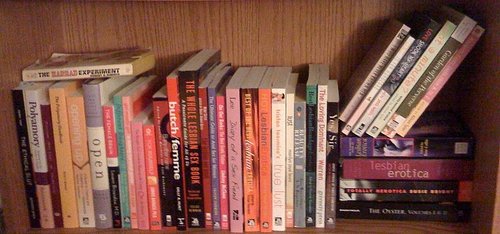
And that’s the question that interests me, because to be honest, the way I first stumbled upon Denizet-Lewis’s project was through criticism of it. Or namely, criticism of how blithely he waves away the gay community he grew up around (which, for context, was the Castro) (and which, also for context, is specifically encapsulated in the line “I couldn’t relate to AIDS or leather chaps, both of which seemed to be afflicting many of the gay men I saw on the corner of Castro and Market”) and how sure he seems to feel that his gay teenage salvation was centered around books, and not the people who were living out those stories around him.
From “You’re Welcome, Benoit Denizet-Lewis“:
I do believe I moved to San Francisco while this person was entering high school, and I’m sorry that apparently five years of age difference created a generational divide so vast that it made him unable “to relate to AIDS,” particularly at a time when his neighbors and chaps-wearing strangers on the street were dropping dead all around him.
And chances are quite good that my friends and I were actually guest-teaching HIV prevention at his very school at the time, which one hopes didn’t make him shove his fingers in his ears too hard in panic (and also hopes maybe made him “relate to” having sex with condoms)? Because while he was running in horror from the community of people who apparently only ever wore chaps (although, most days I showed up for work in nipple clamps and women’s shoes, obviously!), they/we were the ones trying to help raise him and keep him from, you know, dying extremely young.
It’s not really a question of one person being right here and another being wrong; it’s about a unique internal experience, which is what books are about and which is ultimately pointless to argue. But it raises an interesting question: what is it about books, that we find something so affirming and important in them when we sometimes can’t find it anywhere else? It would seem, based on at least anecdotal evidence, that Denizet-Lewis did have plenty of affirmation and support from other avenues. He grew up in San Francisco; based on his story his parents seem perhaps not like the gay teenager cheerleaders one would hope for, but certainly not abusive or homophobic; he had workshops on HIV prevention IN SCHOOL, which is more than (guessing!) 95% of kids can probably claim now (thanks, abstinence-only education!). This isn’t to find fault with him for the fact that those experiences apparently didn’t resonate, but to ask about the ones that did.

It really does seem universal that we all have at least one, possibly dozens, of books that were our lifeline, that got us through and made the world make sense when nothing else could. As one of Denizet-Lewis’s contributors notes:
“I am not being hyperbolic when I say that Good Times, Bad Times saved my life,” Mississippi Sissy author Kevin Sessums emailed me to say about James Kirkwood’s little-known novel, which is set in a boarding school run by an evil headmaster. “I read this it thrice during my teenage years in which I suddenly began using words like ‘thrice.’ It’s about the nuances of male bonding as well as the price one pays for being different and, yes, defiant. Just typing these sentences makes me want to read it for a fourth time. I’m sure it will speak just as profoundly to me as an adult because somewhere deep within the truest part of myself is still that 16-year-old from Mississippi who longed for romantic love when what he was offered had to be defined as friendship.”
I don’t have an answer here, just a question (and a similar deep love and indebtedness to James Baldwin): what is it about us, and about books? Why do they speak to us when nothing else does? What’s your number one gay book of all time, and why does it mean so much to you? What’s the story, morning glory?



Comments
I DID secretly read Annie on My Mind in the high school library when I was 16 or 17. I didn’t figure out the whole ‘gay’ thing for another few years, but I had *SO* many feelings about it. I later secretly bought the book and decided that I had to hide it, for some reason? I don’t know.
Also, I thoroughly enjoyed “How I Paid for College: A Novel of Sex, Theft, Friendship & Musical Theater”. It’s pretty quality, all around. Imagine Glee in book form, plus crazier antics and minus a creepy pedo teacher. And possibly gayer, if it’s possible.
I actually BOUGHT Annie on My Mind from a bookstore, while I was with my parents, when I was 11 or so. I was scared shitless.
That IS brave! I fully embraced the anonymity of online shopping, and used a gift card to fully ensure that it wouldn’t show up on any sort of bank statements. Paranoia, much?
me too! and then I read it on a school trip and hid it behind my bookshelf so my parents wouldn’t know
yay! I loved “How I paid for college…”
I read it in college and sadly I paid for school the old fashioned way. Lots and lots of loans.
Okay, I’m putting Annie on My Mind on my to-read list
I didn’t like Annie on My Mind. I read it a couple years ago, because I felt like a bad lesbian for not having read it, but now I feel like an even worse one for not having enjoyed it. I think it was just too dated for me to really enjoy, or something.
Yeah, same here. You’re not a bad lesbian, or at least not worse than I am =P
blasphemy! every lesbian must read and love “annie on my mind.” the moral fabric of our society depends on it…oh, wait…jk.
:) every reader her book. there are lots of others.
I hadn’t even heard of Annie on My Mind until today let alone actually read it
I think it has to do with *when* you read it. When I read it as a closeted 15-year-old, it was a revelation. I haven’t read it since, and I think doing so now as an out 28-year-old would make me barf. ;)
oooh, good insight.
Yeah I just read it and I’m 28….It was lightly cute but not revelatory at all. You’re probably right that it’s really a book for kids in that situation more than adults who have grown beyond it.
i recommend “Bermudez Triangle” by Maureen Johnson if you want something a little more up-to-date or “Girl Walking Backwards” by Bett Williams, if you want something darker, less mainstream.
i also really enjoyed “Down to the Bone” by Mayra Lazara Dole.
i clung to books because they could privately save me. my parents decided that they could de-gay me by taking away just about every line to the outside world. so i had books. besides harry potter, i read books by julie ann peters, alex sanchez, maureen johnson, and michelle tea. and i’d read them after everyone else went to bed. they made my home-life bearable and also reassured me that i wasn’t crazy, my family was.
I’ve read and loved books by all the other authors you mention, so I just added Michelle Tea to my to-read list. Thanks :D
First off, I want to say that this is my first post to Autostraddle and I’m so excited!
Secondly, I would like to note that I have read Rubyfruit Jungle and loved it.
Thirdly, I have recently found the author Georgia Beers and am on my second book of hers (first one was Starting From Scratch, the second is Too Close To Touch). So far I LOVE her work – her characters are so in depth and her writing enables you to feel the emoitions of the characters. You can actually relate with them.
They (characters) aren’t middle school/high schoolers, either. They are, typically, working professionals in their 20s, 30s, and 40s. So, for me, I am able to enjoy the books more than I was able to enjoy something like Annie On My Mind – where they characters were still dealing with classmates/teachers/parents, etc.
Just putting it out there – you may want to check her out.
And lastly, I’m not sure that at this point I could pick my all-time fave gay book. I feel like there is probably a lot of ground I have yet to be aware of as far as gay literature goes and that a lot of awesomeness awaits us.
I talked about my Sappho tattoo way back in AS Poetry Week, and how as a young lass Sappho felt intimate and secret and electric and a punch in my gut, but my #1 gay book, the one that made me go, “God, yes, that’s exactly how it feels, I so desperately want this, I’m TERRIFIED of this” was Terry Moore’s comic book masterpiece “Strangers in Paradise.” I grabbed the first trade collection as a sophomore in high school at the recommendation of a particularly righteous comic shop fella (four for you, Atomic Comics in Phoenix!) and GOD. It slaughtered me. Back then, I would get so angry at Francine, because Katchoo LOVED HER, wanted to BE WITH HER, and there I was, scared and so deeply in the closet, wishing that my best friend loved me that way, and Francine would shrug it off, over and over again. I wanted her to be brave for me, brave the way I wished I was. SiP was a constant through high school, through college, and the series would end before I was brave. I read the last issue in my car, parked outside the apartment I shared with my boyfriend, and sobbed, so jealous of their happy ending, so convinced that this apartment, this LIFE, was IT for me. But Francine had found her courage. And eventually, so did I.
I’ve got my girlfriend working her way through the series right now, so we’ll see how it holds up when it’s not so formative.
Oh my gawd, yes, Strangers in Paradise. I was living in a miserably crowded apartment on summer break during college when I first discovered them. One of my roommates worked at a bookstore and I would come visit her briefly and go sit in a chair and devour those books (since I had no money to actually buy them). Thanks for bringing back bittersweet memories.
So many books I haven’t read…
For me, my school and town libraries were increadibly selective. And for the most part, the only glimpses of LGBT characters and storylines that snuck under the small conservative town radar were Young Adult.
“Boy Meets Boy”, “The Realm of Possibility”, “Night Kites”, “I’ll Get There, It Better Be Worth the Trip” “I Am Not Myself These Days: A Memoir” “Off The Map”… I’ve dabbled in “The Color Purple” here and there… I’m definitely writing these down.
I had the same problem with the library system in the (ridiculously large, scarily conservative) city where I live! I combed the bookshelves for queer books, and came up with a handful of David Levithan novels, which were great, but sadly lacking in well developed queer girl characters.
Yes. While I love his prose, it is truly lacking in female queer exposure. Though, to be fair, I have a hard time finding many lesbian/queer-female identified books in general. That’s why I love these lists.
Queer books mean a whole lot to me. I’m reading Stone Butch Blues right now and it is breaking my heart in the best possible way.
I think my love of books is partly because all that other stuff- the visible presence of other queer people, the ability to have an in-the-flesh community, support and resources- seemed really distant and impossible to me. I didn’t know any LGBT people when I was coming out; there weren’t- to my knowledge- any out queer kids in my area and anywhere I went to try and reach out to LGBT people I’d have to have gone alone. Which was (and kinda still is..) terrifying. As for books vs. TV and movies- I hadn’t really seen any TV or movies with lesbian content (except for “But I’m a Cheerleader” which I still love) and I think didn’t come to them until a little later. Reading felt less “incriminating” somehow, it was familiar and quiet (unlike films which my parents might overhear). Plus books always felt more representative to me in a way- characters are written about in novels that television producers would be unwilling to support. And when I started reading non-fiction/bordering-on-theoretical stuff I found it really gave a language to my feelings and experiences in a way that other mediums still don’t. Yay books!
I own a copy of Stone Butch Blues- it may actually be my favorite book. *wails at how heartbreaking it is*
I’ve read Stone Butch Blues several times now, and it always breaks my heart
Seriously, I thought I was doing ok with it but I got to one part last night and I just couldn’t help myself- I cried and cried. But it is so so worth it.
A lot of these books I’ve never heard of or read… Time to make a reading list.
“What Happened to Lani Garver” made a huge impact on me in middle school. I used to read it and listen to Dashboard and have lots of feelings. /emo I also used to read tons of gay web comics and watch But I’m A Cheerleader (and I was a cheerleader!) as much as possible.
The Color Purple. First “real” book I read, turned out to also be very queer (and with the whole sexual abuse thing, arguably inappropriate for a 12-year-old, but whatevs) and very eye opening.
Yes. The Color Purple made me cry real tears. I read it in one day, and I cried an ocean.
Actually, bookshop people were the first people who I came out to. I remember feeling so brave queuing up with “Our Lives Out Loud” (Katherine Zappone and Ann Louise Gilligan) and placing it in on the counter, it felt like a positive action and an admission of sorts.
Seems a bit silly now, but I still smile when I pass the W section in the bookshop or library (Alice Walker, Sarah Waters, Jeanette Winterson, Virginia Woolf). There our lives appear, an affirmation of sorts… Now I’m wise and of the world, I can see that I have queer brothers and sisters everywhere. But there was definitely a time when the only place I knew could go was between the covers of a book, and the only people who knew I was going there were behind the counter in the bookshop. I wonder do they even realise the massive life event they were part of?
The W section, this is so true!
I used to just type ‘lesbian’ into google but not click any links. Then I got a good computer that was less likely to freeze on something incriminating, and it was like, MIND. (sorry to be cheesy) BLOOOWN. I bought a book about a lesbian ballerina in an institution for eating disorders. Cost 1p and it was the most depressing thing I’ve ever read, but there was a lesbian sex scene in it. I freeeeaked out.
I think ‘Carol’ or ‘Fried green tomatoes at the whistle stop cafe’ are my favourites now. Lesbian literature is awesome. So is the internet. Seriously, I found AMAZON, and i was like, “DO PEOPLE KNOW HOW MANY LESBIAN BOOKS THERE ARE? THERE IS A SECTION! A LESBIAN! BOOK! SECTION!”
it is a shiny, pretty section. *yay*
I would like to start a petition to make it rainbow coloured. I know, I know, the Mormons would get all upset that the gays get special treatment, but I think it would make it POP.
*makes a note*
amazon <3 pretty much saved me !
Mrs Dalloway. Just the line when she says that kissing Sally was the purest moment of happiness in her life, that was enough to make me realise I was gay at thirteen.
Ok, so I feel like this would be a good time to admit to a terrible and shameful secret. Namely, I read ‘Tipping the Velvet’ and I didn’t like it.
Everyone told me it was the best queer book they ever read, but I thought it was… silly.
Please, someone tell me I don’t have to turn in my queer licence!
I just read “Fingersmith” ( same author) and yeah…I just. It was all right. Not bad, but not great.
I’ve read other queer fiction that like made my life though. When I was a little baby queermo- “The Realm of Possibility” had a section narrated by this girl in love with her best friend that would write songs for her. At 14, my life.
“Fingersmith” was the first lesbian novel I read. And I have to say, I was disappointed in the lack of um…lesbian-ness in the story. Definitely more of a period thriller, if you’re into that. Just not the best novel if you want to really explore the main character’s sexuality. Sarah Waters does write beautifully, though.
I do want to read Tipping the Velvet though, I saw the movie and thought it was amazing.
I really like Fingersmith, I always feels like the more I read it the more I get out of it. I think it’s the novel which most shows how much a great storyteller Sarah Waters is – just so many layers.
I also like The Night Watch, though I know it when it came out that had quite mixed reviews. It does have a really mixed ensemble of characters but I enjoy that, and it’s told backwards which is a pretty interesting tactic. It’s been turned into a drama for the BBC though they haven’t aired it yet and I’m wondering how that’s going to have turned out.
Tipping the Velvet didn’t blow me away – I do think the book is better than the series though. I suppose I just didn’t connect with the characters much – I only really started liking Nan towards the end but it just felt lacking compared to Waters’ other books (perhaps this was because it was her first novel or maybe it’s because it draws influences from melodrama and that’s not the usual sort of genre I’d go for? I don’t know, I’m babbling…)
I’ve only watched the movies… BBC makes some GOOD book adaptations. And I mean good. I enjoy them immensely and recommend them wholeheartedly. ;)
But winking aside, I am not really a fan of Sarah Waters’ writing style. It’s soooo descriptive that I just get kind of lost. Maybe that makes me simple-minded. Anyway, the movies are hot.
I couldn’t get into Tipping the Velvet either–I quit fifty pages in :(
there are loads of other great queer-affirming books out there though!
I’d say that line in Mrs. Dalloway about kissing Sally is one of the bravest moments in fiction.
I haven’t heard of so many of these…but I have felt the need to send books I buy on Amazon to a friend’s house instead of my parent’s just in case they ask what was in the package…
BUT I’m moving out so don’t need to worry about that anymore and I can start to tackle my very long book list!!
im really excited for you!! amazon is a life saver!! they have a wicked lgbt section!!
– side note haha i used to cover all my gay books in other boring covers ahaha
I can never find LGBT books in Ireland outside of the internet :/
Emma Donoghue :) She’s both Irish and Lesbian!
Strange as it is, the first queer books I really fell in love with were not about lesbians per se- they were by David Levithan, books like “Boy Meets Boy” and “The Realm of Possibility” (which has a bit about a lesbian but is centered around a gay couple. But the whole thing in general is very sex-positive and about teenage life/growing up/friendships/etc, I still love it.)
Something about the way he writes is so compelling to me. I want his author-voice to narrate my life. It’s absolutely calming yet totally wonderful.
I mean, Boy Meets Boy is about a sideways town in which being gay is a complete non-problem and everyone regards it as normal. The kind of escapist fantasy I absolutely craved without knowing it.
Some of the first lesbian books I think I read were “Empress of the World” which yeah, pretty much blew my mind at the time. Queer fiction (or media in general) was like this whole world that opened up to me once I found out it existed and it was all so INTERESTING because I could relate perfectly.
tl;dr anyone else love David Levithan as much as me? I even book-marked my favorite parts of “RoP” with mutliple post-its for my favorite characters and underlined the best bits in light green pen.
i heart david levithan. “wide awake” and “love is the higher law” are two of my favorites (and “boy meets boy,” of course).
he does have a fun style and i like that in some of his “worlds” there is no hate. sometimes it’s not about the struggle, the teens can be teens, the quarterback can be a drag queen, and everything is all okay.
i don’t think i’ve read “realm of possibility” though, is that the one that is a verse novel?
Yeah, that’s the one. But it’s interesting because each chapter is from the point of view of a different person, and each person knows other people in the book and will mention them in passing. The fun part is figuring out who knows who and how. There ends up being something like 15-20 characters who each narrate in a different poetic style that suits their personality.
i will definitely check it out. :)
You’re not the only one. LOVE David Levithan. Love. It was great to read Boy Meets Boy, which treats the gay love story as just that; a love story.
Also, he’s super nice and does lots of book events in NY. Always a plus.
Empress of the World. gawd, I don’t know how many times I read that – guardedly, in my bedroom. That book didn’t completely clue me in that I was gay, but everything felt right. I had a serious crush on Battle. :)
that one stuck with me, too. i had a similar summer camp/leadership conference experience (minus the kissy bits, unfortunately).
oh my goodness, though, battle…
I read Empress of the World! I don’t really remember anything about it so I have no feelings to share but I’m excited because I read something that someone else also read and I feel the need to affirm that!
points! you get points! #andvalidation
I totally love David Levithan too. The Realm of Possibility is possibly my favourite book that I’ve read so far. Opening it up and reading that first line “i’ve never smoked a cigarette with anyone but jed” is like stepping back to the me I was in high school, who got overly emotional over “Love Songs for Elizabeth,” or the girl buying pot for her mother. “My girlfriend is in love with Holden Caulfield” still makes me smile.
I haven’t read his newer stuff though, maybe I’m finally too old for it? That’s a sad thought.
you’re never too old for any book. #justsayin
but if it’s an issue, he does have an adult book out now: “The Lover’s Dictionary”
David.
<3
I love him, regardless of the lack of lesbian exposure.
I did a piece from Realm of Possibility for performance forensics my senior year of high school.
i really loved this book “entries from a hot pink notebook” that was like a YA novel about a closeted gay boy? god i loved that fucking book
Confessions of a Mask, by Yukio Mishima was the first queer book i read, & it certainly gave me a lot to ponder. i recommend it, but it’s certainly not for everyone.
ohh i love books:
-1st chapters purchase: same sex in the city. being 16 and reading this was amazing… i read it before knowing what the l word was… it still seems better than the l word.
first “gay” book i bought with my own credit card- online all the second hand book stores pretty much 1 sucks and chapters never has anything gay….. :
1. i bought 5 Eileen Myles books and then recommended them to everyone! i didnt care lgbt or straight. she is amazing!
– not me ( read this book maybe 40 times… not kidding)
– cool for you
– sorry tree
-the importance of being iceland
– the new fuck you- stories
i read skies online at my university library… i need to buy inferno!
2. Alison Bechdel’s book: fun home: i wasnt brave enough to order dykes to watch out for…
3. Federico Garcia Lorca
as for books ive read in the library:
– i think ive read every social theory/ humanities/ anthropological/ gender studies/ poetry/ novel etc etc etc book in the library and probably the sources sited in the back… for 5 years.
Others:
– the childrens hour- lillian hellman (one of the first i found… i think someone recommended it…. i dont know why!!!! she dies in the end..!! and its sad and not a happy gay ending)
i tried to read well of loneliness when i was like 10 because i found in the basement… i think i skipped alot of pages to the good stuff/ sorta hinted at stuff.
– sometimes i think i grew up in the dark aged because there really wasnt alot of lgbt books especially in the stores here… but then again i had no idea what to look for soooooo
– i read alot of male poets and pretty much enjoyed the descriptions of the females :D but yeahhhhh we need more lgbt writers and more promotion or at least a colourful sign over selected authors…. i had no idea these books existed when i was 9-15!!!!! seriously and that was 1998-2004.
in short im buying a ton of books! with all the lovely recommendations! i love autostraddle!
I found Rubyfruit Jungle and another book that I can’t for the life of me at the library in HS and it absofuckinglutely blew my mind at the time because it was finally with feelings that I GOT!!! I’m sure to this day there is probably some note attached to my account for all the times I checked it out….
When I was 12, my mom handed me Rubyfruit Jungle and told me to read it. Apparently someone had told her it was a Christian book. That one was an eye-opener…
The first gay book I ever read was “Rainbow Boys”. It was with a couple other books my catholic middle school had yet to approve and (because I’d read every single other book in the library) the school librarian had given me the book to read as long as I returned it…I still have it in a draw in my room.
I went on to read every other book I could find with gay guys in them (my favorite was Hero) but I didn’t find any teen books with lesbians until I was well into high school and had realized my sexuality.
I am old enough and grew up in an unsophisticated enough place that I actually didn’t know being gay was a real thing until I got to college.
There was a brief window of time — a few years — between finally daring to come out, and nevertheless ending up marrying a man. During that window of time I accumulated a small collection of lesbian books. I got rid of most of them after I got married. I always knew (so did he) that I was still a lesbian, but it felt weird somehow to keep the stash around.
We split up a couple of years ago. I still have & treasure the two books I could never part with: ANNIE ON MY MIND and DYKES TO WATCH OUT FOR. Even when I had them turned backward on the shelf so their spines were hidden (ugh so not proud of that), they were this tiny but unbreakable thread connecting me to this other piece of me that may have been turned backward so you couldn’t see it but was still inextricably part of who I was.
I read just about every book containing queer content that I could get my hands on from the ages of 12-20ish. Big ones were David Levithan, Empress of the World, Am I Blue?, Annie On My Mind, Keeping You A Secret, Francesca Lia Block, Dare Truth or Promise, Jaqueline Woodson, Please Don’t Kill the Freshman. I also ransacked the queer studies section of my college library one summer. There were some photo essays of queer women and a particular chapter in an otherwise unlikable Andrew Sullivan book that really jumped out at me, plus Ariel Schrag and Dykes to Watch Out For.
I would say that books really did save my life as a queer youth and a generally unhappy and confused child. Books with queer characters told me that I wasn’t alone, even if the struggles they depicted terrified me. Even if for years I would slip the desired book into a stack of others and hide in a quiet corner of the library to read it as fast as possible, too ashamed of being seen with anything ‘gay’ to check it out or take it home.
It was the internet though that really changed my life and helped me learn how to live openly and confidently as a gay girl. It’s important to be kept sane but eventually you have to develop a life worth living and the specifically gay literature I’ve seen just doesn’t help with that.
Oh, Am I Blue?. What a brilliant, brilliant book.
Oh my God. “Am I Blue?” was the book that changed my life.
I can still remember driving to the public library one day after school to look for LGBT books, stumbling upon “Am I Blue?” and sitting in the back of the library reading it, amazed.
I can also remember daydreaming about everyone gay turning blue, and I turned sky blue and it not only affirmed my sexuality but forced me to out myself to the girl I liked.
I never had the chance to really sit and read the whole thing cover-to-cover, and I wish I could. Back then I was too afraid to even THINK about checking the book out from the library.
At some point in early high school I read part of Annie on My Mind while hiding in the library, then quickly hid it when my mother approached me and said it was time to leave (I was too afraid to check it out). So I never got to finish it but the little bit I got through stayed with me.
I read The Hours after watching the movie and getting all sorts of funny feelings during the kissing scenes. I needed to experience that in book form too.
When I was 15 I read Angels in America and that really changed my life. Made me want to write plays, specifically super-gay plays. No lesbians but I had never read something so amazing.
Also, how could I forget, Antes que anochezca by Reinaldo Arenas (translated as Before Night Falls). As a gay Cuban-American that book was really important to me.
the queer book i most remember reading early on was a collection of lesbian vampire erotica. i know that i read other queer books but that book was memorable: a semi-gag gift given to me sophomore year of high school about a year after i came out to my friends. none of the stories were that great but i can see it on my shelf from where i’m sitting.
i read rubyfruit jungle just this past year and i have a brief story about getting it. i came out to my parents early 2010 and while they’re generally okay with me being gay, i know it makes them somewhat uncomfortable. we pretty much never talk about it. i had read about rubyfruit jungle and absent mindedly put it on my amazon wishlist that they use for birthdays and christmas. so christmas day 2010 we’re unwrapping gifts and ta-da! i got rubyfruit jungle from them! i thanked them and they asked me what it was about. my description? “uhhh ladies… nice ladies?” and then i learned that that wasn’t even true. ah well
Wow, now that I think about all the queer books I read in middle and high school, I have no idea how I didn’t jump out of the closet a lot sooner. I remember really connecting to queer books, but also to any books with an “outsider” theme.
Empress of the World by Sara Ryan is the book I remember as being the most influential at that time. I found a sense of belonging in that book. Everything just felt right even though I didn’t quite know or understand all of it just yet. I remember it being eye-opening, but also like I was coming home.
Ellen Wittlinger’s Hard Love and Razzle were another two favorites. I read Julie Anne Peter’s stuff – Define “Normal” also being a favorite. Annie on My Mind. Geography Club by Brent Hartinger. The Bermudez Triangle by Maureen Johnson which I arbitrarily picked up off a shelf and bought; I was pleasantly surprised to find out it was gay.
I basically picked through my conservative library’s entire limited selection of LGBT literature. I always remember hiding the gay books in between a stack of others and making sure to put it out of sight once I got it home. My mom over-sheltered us and was entirely too nosy.
My reading list just got so much longer after reading this thread. It was already HUGE – like, on a spreadsheet huge.
I was the luckiest girl ever when I found Am I Blue? (edited by Bruce Coville) in the local used bookstore. I read that collection through about a hundred times. And then I lost my copy (which means, I leant it out and it never got back to me), and my mum bought me a new copy for my birthday. Because I have the best mum ever (other books she has gifted to me include: Eve Sedgwick, Judith Butler, Audre Lorde, Staceyann Chin — seriously, guys, I am the luckiest daughter in the world).
But my number one queer lit crucial to my life as a lesbian? Slash fanfiction. Thank you, internet, for making me realize that being gay is awesome.
i really enjoyed the xena/gabby stuff on fanfiction.net, won’t lie (and other geeky series)…and then Melissa Good (who wrote some of the BEST stuff on there) got to write an episode! very cool.
the internet is a livesaver.
Amen to that. Slash fanfiction changed my life.
I <3 your screen name :)
#justsayin
THIS. I lived in a super conservative town and definitely didn’t have the balls to buy gay books, but I read a LOT of gayGayGAY fanfiction, specifically Harry Potter fanfiction. I loved Harry/Draco and Hermione/Ginny. I now find this slightly embarrassing, but hey, you’ve gotta get your queer lit from somewhere. This was free and secret!
So I didn’t read much queer lit when I was a kid because they didn’t have any queer sci-fi at my local library, at least not that I could find. But I was terribly bullied in middle school, and books with outsiders really drew me in and kept me (relatively) sane. I was obsessed with Anne McCaffrey’s Harper Hall trilogy – well, the third book less (who cares about Piemur, I mean really) but the first two spoke to my heart. Plus I’m pretty sure Mirrim was totally gay for Menolly. Just sayin’. :D
You’d probably have liked Mercedes Lackey’s Heralds of Valdemar series — they were my go-to brain candy in middle school. She only had a couple of incidentally lesbian background characters, but the main character in one of the trilogies (The Last Herald Mage) discovers he is gay, falls in love, deals with his family’s wrath, etc. Lackey’s stuff is kind of up and down in quality, but she has a lot of young outsider/strong female characters generally, and they’re fun escapist fantasies.
love that series !- all the books- and in my head, Tarma and Kethry, whom i actually discovered in Mercedes’ short stories (published in Marion Zimmer Bradley’s “Sword & Scorceress” anthologies) are totally a couple.
I could never really get into Lackey’s stuff, at least not at that age. Maybe I’d like it more now? IDK
Pern was pretty much as close as I got to fantasy back then. I’m still much more on the sci-fi end of spec fic than the fantasy end.
Technically the first queer thing I read was a chapter of Am I Blue — I found it in my older sister’s homework (what class was she taking??! something along the lines of philosophy, I think) and it blew my 13-year-old mind. But not enough to come out at all…
But Annie on my Mind was the first queer book I actually sought out, and it still has a treasured place on my bookshelf. It was dated already, but it didn’t matter. I also loved Empress of the World (recommended by my first girlfriend) and Am I Blue? when I finally got the whole book out of the library. And Virginia Woolf’s Orlando! Found that accidentally and loved it. And of course, David Levithan. I still re-read The Realm of Possibility when I’m sad — his stuff never gets old.
I actually cried when I picked up Whipping Girl by Julia Serano because it was the first time I had let myself read any kind of queer/gender related or even feminist literature and it was kind of like “Holy shit, I can’t believe I’m actually seeing this stuff on paper. Someone else thinks this.” it was affirming and kind of overwhelming.
For the longest time I would actually put a cover over anything gay/queer/feminism related because I didn’t feel brave enough to answer the people who asked me questions about what I read and what I thought about it. I mean, it’s pretty funny considering that now the bulk of my book collection is composed of stuff like The Ethical Slut and things on bondage and genderfuckiness and generally political subject matter pertaining to myself and my sexuality and that my bookshelves are basically the first thing you see at my place. (Hi ho, run on sentence, away!) I got that way by walking around with my Feinberg or Bornstein and just being up to dialogue when others commented.
So I think queer lit has helped me be more outspoken, alongside any of the heartening or intellectual enrichment that I’ve gotten from it.
Whipping Girl was also my first queer/gender/feminist related book and yeah, it was totally affirming and overwhelming as well as changing/expanding the way I thought about things.
I can also relate to the whole hiding books thing; most of my queer books are a little battle-weary from being crammed into hidden spaces in my room at one point or another (which, apparently, I didn’t do well enough since my mother was/is concerned that I’ve been “indoctrinated into a seedy underclass” by the “gay reading list”…oh well). But I’m much more open when I’m out of my parents house- I no longer have any problems reading stuff like Butch Is a Noun, Dykes to Watch out For, Gender Outlaw etc on the bus/in cafes/in the park, which is a big improvement :D
Ah! Love your avatar.
the first queer book i read was The Well of Loneliness and that was a mistake. i felt doomed (but i already felt doomed and the mirrored experience in the book felt somewhat…comforting?). then i read Hood (Emma Donoghue) and that was good but it was so so sad. the girlfriend is dead from the beginning. she’s dead and she cheated. it was looking pretty bleak for me.
but then i read Stir Fry (also by Donoghue) which i got from the library cuz it’s out of print and i don’t remember it very well but i think there was some happiness there, some girl-on-girl happiness. then a girl i had two dates with gave me Tipping the Velvet and I gave her Hood and that didn’t work out the girl but Tipping the Velvet was good. then i read everything Sarah Waters wrote (Fingersmith was my favorite) until i got to Affinity and that was a big cock tease so i said fuck it. no more lesbian fiction for me. i started reading Nick Hornby and Harry Potter.
I haven’t actually read any real lesbian literature yet, plenty of outsider style books, just been dragging my heels on the soul searchy and weird stuff I’m sure will happen upon reading anything I can relate to.
I must confess, my initial foray into queer writing was reading the Beebo Brinker books! =D
Oh man, I’ve read “I Am a Woman” and I was surprised at how good it was. I really want to read “Beebo Brinker.”
“Under the Mink” by Lisa Davis is one of those fun reads that completely sucks you into another world. It’s a sort-of murder mystery set in 1949. The main character is a drag king and it’s full of drag queens, socialites, and historical flavor.
It’s out of print but you can get it used from Amazon or BN.
After reading all the entries thus far, it looks like I came to LGBT literature in a completely ass-backwards way.
I was kind of an oblivious kid with semi-conservative parents, so I didn’t even know that being queer was a thing that people did (must less that it was a valid option for my life) until a friend turned me onto Anne Rice novels in 8th grade. So much explicit sex! (And vampires!) And some of it was gay! (Gay vampires!) Talk about having one’s mind blown, but apparently it was just what a great big perv like me wanted because I proceeded to devour everything I could throughout high school (it was astonishingly easy to get a hold of the Beauty Trilogy at sixteen, legitimately bought with actual money in a retail bookstore in Enterprise, AL; I really don’t think those people knew what they were doing).
Then, I discovered slash fan fiction with my high-speed internet connection in college (particularly Xena/Gabby and Ares/Anybody; later any combination in the Buffyverse). When I finally got around to embracing my queer self on my own terms during my early-to-mid twenties, I also began seeking out work that addressed my discomfort with any kind of gender stereotype. Through Amazon, I found the radical stylings of Riki Wilchins’ _Read My Lips_, the collection of essays and stories she co-edited with Joan Nestle and Clare Howell called _Genderqueer_, the beautiful science and history of Anne Fausto-Sterling’s _Sexing the Body_, and the long, mind-bending haul that is Judith Butler’s _Bodies that Matter_. It was around this time that I also started taking advantage of Netflix and the fact that I lived alone 3000 miles away from my parents, which led me to the works of Sarah Butler (_Tipping the Velvet_ is such a fun, crazy romp and the British rock super hard with their love of the mini-series) and the wide and wonderful world of LGBT cinema (particularly the documentaries!).
I’d like to say that I’ve refined my tastes over the years, but all I know for certain is that they have evolved. And that I’ll be adding many more books to my must-read list thanks to this thread. Thank you, Autostraddle!
(Damn, that’s a long post. You make me feel feelings and want to share . . . in parenthesis!)
i think the queer book that saved my life the most is “skin: talking about sex, class & literature” by dorothy allison. it’s not fiction, just a bunch of essays. but they are amazing.
this is a great post. sherman alexie (not a queer author, but a fierce and powerful ally who once said, “homophobia makes me wish that i sucked dick,”) recently wrote a really amazing article about the redemptive power in teens reading books with “adult” themes. It’s called “Why The Best Kids’ Books Are Written In Blood” and it’s here if anyone wants to read it: http://blogs.wsj.com/speakeasy/2011/06/09/why-the-best-kids-books-are-written-in-blood/
When I was 15 my Dad gave me a copy of Virginia Woolf’s ‘Orlando’ When I was 16 I finally got around to reading it. Suffice to say I didn’t understand the message, so I re-read it and re-read it and re-read it. By the time I finished, I realised I was gay. I realised my Dad knew I was gay and I realised he was ok with me being gay.
Good book.
Yes! I loved Orlando so much. It’s such an amazing book and not only does it talk a lot about gender issues, it also examines the evolution of British society over the past few centuries and is seriously funny on top. It’s my favourite book ever.
I loved Annie on my mind!
I definitely think is one of those books that you should read before you’re an adult. like perks of being a wallflower. if you read it when you’re like 30 and are working and somewhat settled, you could find it boring,silly, I guess.
I wonder if there’s a name of books you should read on your own coming-of-age path.
I love books, I should say. I really,really,really do. I remember wanting to read even before I learned how. I would beg my parents to read me just one more story.one more chapter.and once I did I was never able to put books down.
from a very young age I loved fantasy and science fiction, and the themes of invasions and monsters and UFOs. I loved Narnia and later on Harry Potter. I’m proud to say I’m a part of the Potter generation. due to my interest in this genre and living in an small town which has a few libraries but not a lot of books, I didn’t began reading literary fiction and YA an queer books until fairly recently. cause none of the bookshops had any of “that sort” of books. they dealt with best-sellers and well, renown books and whatever else dripped down. when I got to uni I had access to a much bigger library and I spent most of my time there. in literature the youngest books were at least 20 years old but the selection was still amazing to me.
only a few years ago, a friend recced perks of being a wallflower to me and I couldn’t find it anywhere so I eventually ordered it off amazon. I think I begged my parents for it. and once I’d read it I wanted more like it cause I had never ever ever related so much to a book. not even harry potter or pride and prejudice, my favourite up til then.
it opened my mind to a whole new world. I began looking for others. reading lists, googling it, etc. then I began reading YA and I eventually found queer YA which was awesome. and through more googling I found more lists and I…obtained… a few books and I read “the vast fields of ordinary” and somehow ran into “annie on my mind” which was amazing.
I recently read “bermudez triangle” and it was fantastic, so very…true I guess. realistic.
so,books are awesome.
it’s weird that i’ve never thought of it before but the only gay book i’ve read is sputnik sweetheart by murakami and it was a present from my favorite bookstore owner whose so awesome cuz he gave it to me when i came out to him. ahhhh how i love reading.
one day my mum caught me reading it, looked at the cover and was like “what’s this?, don’t let one of your brothers see it ok”. she thought it was some novel with a lot of sexual content(hehehehe) i’m fortunate that my mum doesn’t flip through my books.
Dear snow, I really like reading “Sputnik Sweetheart.” I remember that’s when I was wearing this oversized plaid wool jacket all the time, and I’d imagine sometimes I was that main character.
Hands down, though, “The Color Purple” is a great book. It broke my 14-year-old heart.